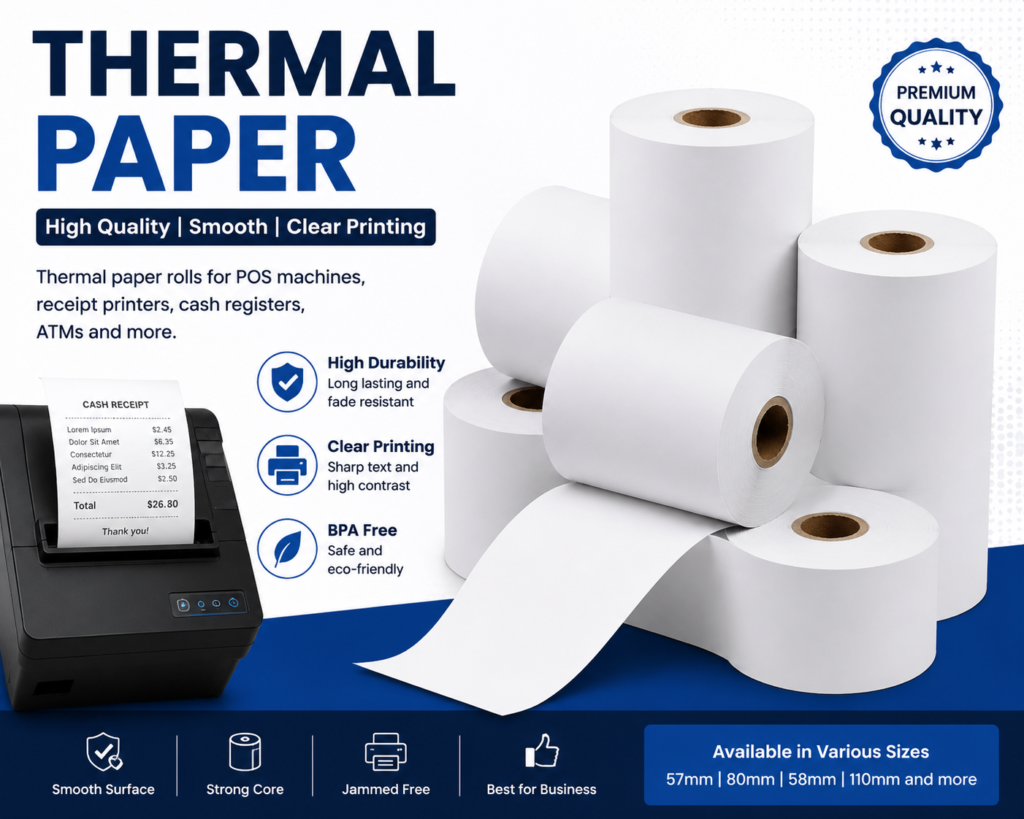
thermal paper
Understanding Thermal Paper in Today’s Business World
Heat-sensitive receipt rolls, thermal paper, and ink-free printing paper are now essential components of contemporary corporate processes. From retail shops to restaurants, pharmacies, courier services, and banking systems, thermal paper plays a crucial role in generating fast and reliable printed output. Unlike traditional printing methods that depend on ink cartridges or ribbons, thermal paper works with heat-based technology. This makes it more efficient, cost-effective, and easier to maintain for businesses that handle a high volume of transactions every day.
What Thermal Paper Actually Is
Thermal paper is a specially coated paper designed to react to heat. When a thermal printer applies heat to its surface, the coating changes color and produces text or images instantly.
Basic working concept
Heat-sensitive coating
The paper is treated with a special chemical layer that reacts when exposed to heat.
Ink-free printing process
No ink or toner is required, which reduces operational costs.
Direct output system
Printing happens instantly without additional processing steps.
Types of Thermal Paper Rolls Used in Industry
Different businesses use different types of thermal paper depending on durability and usage requirements.
Standard thermal paper rolls
Retail and POS usage
Most commonly used in supermarkets, shops, and billing counters.
Cost-effective solution
Suitable for daily high-volume printing needs.
BPA-free thermal paper
Safer material composition
Manufactured without harmful BPA chemicals.
Health-conscious option
Preferred in food-related and healthcare industries.
Long-lasting thermal paper
Improved durability
Designed to keep printed text readable for longer periods.
Resistance to fading
Better protection against heat, light, and storage conditions.
How Thermal Paper Printing Works
The printing process using thermal paper rolls is simple, cost-effective, and highly efficient.
Step-by-step process
Step 1: Printer heating
The thermal print head generates heat on specific areas.
Step 2: Chemical reaction
The coated layer reacts to heat and changes color.
Step 3: Image formation
Text, numbers, or barcodes appear instantly on the paper.
Applications of Thermal Paper in Different Industries
Thermal paper is used in multiple industries where fast printing is required.
Retail industry
Billing receipts
Used for printing customer invoices and transaction records.
Price labels
Helps in managing product pricing efficiently.
Food and hospitality sector
Order tickets
Restaurants use thermal printers for kitchen orders.
Fast billing systems
Speeds up customer checkout process.
Logistics and courier services
Shipping labels
Used for tracking parcels and deliveries.
Warehouse management
Helps organize inventory systems.
Healthcare industry
Medical reports
Used for printing lab results and prescriptions.
Patient records
Ensures proper documentation in hospitals.
Key Features of Thermal Paper Rolls
Fast printing performance
High-speed output
Ideal for busy retail environments.
Efficient workflow
Reduces waiting time at billing counters.
Cost efficiency
No ink requirement
Eliminates the need for ink cartridges.
Low maintenance cost
Reduces printer servicing expenses.
High print quality
Clear output
Produces sharp and readable text.
Consistent results
Maintains quality throughout the roll.
Benefits of Using Thermal Paper
Operational benefits
Faster transactions
Improves billing speed in businesses.
Smooth operations
Reduces delays in printing tasks.
Financial benefits
Reduced printing cost
No ink or toner expenses.
Long-term savings
Improves overall cost efficiency.
Practical benefits
Easy usage
Simple to load and operate.
Compact storage
Easy to store in bulk quantities.
Factors to Consider When Choosing Thermal Paper
Paper quality
Smooth coating
Ensures better print clarity.
Compatibility
Printer matching
Must match specific thermal printer requirements.
Storage conditions
Heat and light sensitivity
Should be stored in cool and dry environments.
Market Trends in Thermal Paper Industry
Growth of POS systems
Digital billing expansion
More businesses are adopting electronic systems.
Retail modernization
Supermarkets increasingly rely on thermal printers.
Technological improvements
BPA-free innovation
Safer and eco-friendly materials are increasing.
Better durability
New coatings reduce fading issues.
Future of Thermal Paper Technology
Sustainable development
Eco-friendly materials
Manufacturers are focusing on greener solutions.
Reduced chemical usage
Safer production methods are being introduced.
Smart printing systems
Advanced POS integration
Thermal printing is becoming more connected with software.
Faster output systems
New technologies improve speed and efficiency.
Importance of Thermal Paper in Modern Business
Thermal paper has become an essential part of modern business operations because it supports speed, accuracy, and cost efficiency. Without it, industries like retail, logistics, and hospitality would struggle with slow and error-prone manual printing methods. Its role in automation makes it a key component of digital business systems.
Frequently Asked Questions (FAQs)
What is thermal paper used for?
Thermal paper is used for printing receipts, labels, tickets, and billing records in different industries.
Does thermal paper need ink?
No, it uses heat-sensitive technology instead of ink or toner.
Where is thermal paper commonly used?
It is widely used in retail shops, restaurants, courier companies, banks, and hospitals.
What is BPA-free thermal paper?
It is thermal paper made without harmful BPA chemicals for safer usage.
Can thermal paper fade over time?
Yes, exposure to heat, light, and poor storage conditions can cause fading.
Is thermal paper cost-effective?
Yes, it reduces ink costs and maintenance expenses significantly.
What type of printers use thermal paper?
POS printers, receipt printers, and barcode printers commonly use thermal paper rolls.
For more related posts and blogs, click here