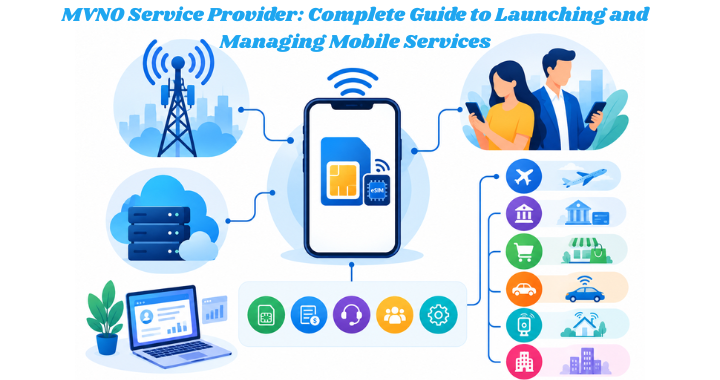
The telecommunications industry is evolving quickly, creating new opportunities for businesses to offer mobile connectivity without building their own network infrastructure. An MVNO service provider enables businesses to launch branded mobile services by using network infrastructure from established Mobile Network Operators (MNOs).
From mobile plans and SIM management to billing, customer support, and digital onboarding, an MVNO can manage many aspects of a telecom business. With the growing adoption of 5G, eSIM, IoT, and digital services, choosing the right technology and infrastructure partner has become essential for businesses entering the mobile market.
What Is an MVNO Service Provider?
An MVNO service provider helps businesses operate mobile services without owning a complete cellular network. Instead, an MVNO purchases network access from an MNO and uses it to provide voice, SMS, and data services under its own brand.
Depending on the business model, an MVNO may manage customer acquisition, pricing, subscriber management, billing, SIM or eSIM activation, customer service, and other operational functions.
This approach allows companies to enter the telecom market with less infrastructure investment while focusing on their target customers and unique service offerings.
Why Choose an MVNO Service Provider?
Launching a mobile service independently can involve significant investment and technical complexity. Working with an experienced provider can simplify the process and help businesses reach the market faster.
1. Faster Market Launch
An MVNO does not need to build cell towers or develop a nationwide radio network. By leveraging an existing MNO infrastructure, businesses can focus on launching their brand, creating mobile plans, and acquiring customers.
A capable MVNO service provider can also provide the technology required for subscriber management, provisioning, billing, and service activation.
2. Reduced Infrastructure Costs
Building a traditional mobile network requires substantial investment in infrastructure, spectrum, network equipment, and operations. MVNOs can reduce these requirements by using existing network capacity.
This makes the MVNO model attractive to startups, enterprises, retailers, fintech companies, and other organizations looking to add mobile connectivity to their portfolio.
3. Flexible Mobile Plans
An MVNO can create customized mobile packages based on its target audience. Plans may include prepaid services, unlimited data, international calling, business connectivity, IoT packages, or specialized data plans.
This flexibility allows MVNOs to target specific customer segments rather than competing solely with traditional telecom operators.
Importance of an MVNO Billing Platform
Billing is one of the most important components of a successful MVNO operation. As subscriber numbers increase, manually managing usage, subscriptions, payments, and invoices can become complicated.
An MVNO billing platform provides the technology needed to automate and manage these processes.
A modern platform can support:
- Subscriber billing
- Usage-based charging
- Recurring payments
- Prepaid and postpaid plans
- Data and voice usage tracking
- Discounts and promotions
- Invoice generation
- Payment management
- Real-time account information
- Multiple pricing plans
An effective MVNO billing platform can help businesses maintain accurate billing while reducing manual processes and improving the overall customer experience.
What Is an MVNO Billing System?
An MVNO billing system is a specialized solution designed to manage the financial and charging operations of a virtual mobile network operator. It connects subscriber usage with pricing plans and generates the appropriate charges.
For example, when a customer uses mobile data, makes a call, or sends an SMS, the MVNO billing system can process that usage according to the customer’s plan.
The system can also support different billing models, including prepaid, postpaid, recurring subscriptions, pay-as-you-go, and usage-based pricing.
A robust billing system is particularly important for MVNOs because flexible pricing is often a major part of their competitive strategy.
Key Features of an MVNO Billing System
When selecting an MVNO billing system, businesses should consider the features required for their current and future operations.
Real-Time Charging
Real-time charging allows the platform to calculate usage and apply charges quickly. This can be especially useful for prepaid plans and usage-based services.
Automated Invoicing
Automated invoice generation reduces administrative work and helps ensure that customers receive accurate bills on time.
Multiple Pricing Models
A flexible MVNO billing system should support different pricing structures. Businesses may need prepaid, postpaid, subscription-based, tiered, or usage-based plans.
Payment Integration
Integration with multiple payment methods can make it easier for customers to pay their bills and renew their services.
Usage Management
The platform should track voice, SMS, and data usage accurately so customers and operators can understand consumption and associated charges.
Reporting and Analytics
Billing data can provide valuable insights into customer behavior, revenue, usage patterns, and plan performance. These insights can help MVNOs optimize their pricing and marketing strategies.
eSIM and Digital MVNO Services
eSIM technology is changing how mobile customers activate and manage connectivity. Instead of physically inserting a SIM card, compatible users can download an electronic SIM profile directly to their devices.
For an MVNO service provider, eSIM can simplify customer onboarding and support digital-first mobile experiences.
A business can combine eSIM activation with an online storefront, automated provisioning, digital payments, and an MVNO billing platform to create a streamlined customer journey.
This is particularly useful for travel companies, fintech brands, IoT businesses, and digital service providers.
MVNOs and 5G Connectivity
5G is creating new opportunities for MVNOs beyond traditional voice and data services. Businesses can develop specialized connectivity solutions for smart devices, enterprises, connected vehicles, industrial applications, and IoT.
An MVNO service provider with access to suitable network infrastructure and modern telecom technology can help businesses take advantage of these opportunities.
As more connected devices enter the market, scalable subscriber management, provisioning, and billing technology will become increasingly important.
How to Select the Right MVNO Service Provider
Choosing an MVNO service provider requires careful consideration of both technology and business requirements.
Network Coverage
Check which MNO networks the provider works with and whether they provide the coverage required by your target customers.
Billing Capabilities
Evaluate the MVNO billing platform and MVNO billing system offered by the provider. Make sure they support your preferred pricing models, payment methods, and billing requirements.
eSIM and SIM Management
Look for support for physical SIMs as well as eSIM technology. Digital activation can improve onboarding and reduce operational friction.
Scalability
Your provider should be able to support growth as your subscriber base expands. The platform should handle increasing transaction volumes without compromising performance.
API and Integration Support
APIs can help connect the MVNO platform with CRM systems, ecommerce platforms, payment gateways, customer portals, and other business applications.
Customer Support
Technical support is another important consideration. A reliable partner should provide assistance with service provisioning, billing issues, integrations, and operational challenges.
The Future of MVNO Services
The future of the MVNO industry is being shaped by eSIM, 5G, IoT, automation, cloud technology, and digital customer experiences. Businesses are increasingly looking beyond traditional telecom models and exploring ways to integrate connectivity into their existing products and services.
An advanced MVNO service provider can give businesses the infrastructure and technology needed to build flexible mobile offerings. At the same time, a reliable MVNO billing platform and MVNO billing system can help manage complex charging, subscriptions, payments, and customer accounts.
As competition in the telecom industry continues to grow, MVNOs that combine reliable connectivity with flexible pricing, digital onboarding, and strong customer experiences will be better positioned for long-term success.
Conclusion
An MVNO service provider can make it easier for businesses to enter the mobile market without investing in an entire network infrastructure. From network access and SIM management to eSIM activation and customer support, the right partner can simplify telecom operations.
However, technology such as an MVNO billing platform and MVNO billing system is equally important. Accurate billing, flexible pricing, automated payments, and real-time usage management can directly influence customer satisfaction and business profitability.
For companies planning to launch or expand an MVNO business, selecting a reliable technology and network partner is an important step toward building a scalable, competitive, and customer-focused mobile service.