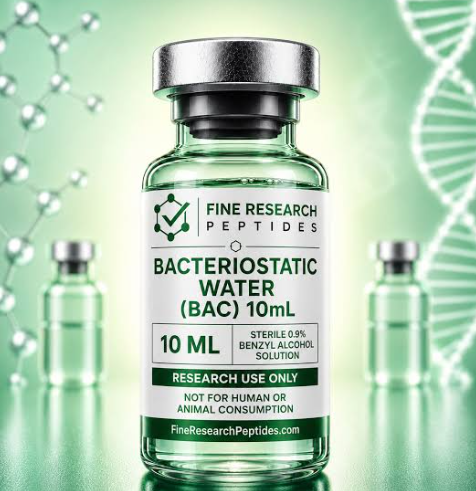
10ml bacteriostatic water is a sterile diluent containing water for injection and a small amount of a bacteriostatic preservative, commonly benzyl alcohol. It is designed for specific applications where a sterile diluent is required and where the presence of a preservative is appropriate. Because it is supplied in a convenient 10 mL volume, this format can be useful in controlled laboratory and clinical settings where measured quantities of sterile diluent are required. Understanding what bacteriostatic water is, how it differs from other sterile diluents, and how it should be handled is important for maintaining appropriate practices and avoiding unsuitable applications.
The term bacteriostatic refers to the ability of the preservative to inhibit the growth of microorganisms under specified conditions; it does not mean that the product can make contaminated materials safe. Consequently, 10ml bacteriostatic water should be treated as a sterile pharmaceutical preparation rather than as ordinary purified water. Its suitability depends on the intended application, the substance being reconstituted, and the instructions associated with the specific product. Users should always follow the applicable product labeling and professional guidance when determining whether bacteriostatic water is appropriate.
What Is 10ml Bacteriostatic Water?
Bacteriostatic water is a sterile water-based preparation formulated with a preservative to help prevent microbial growth after the container has been entered, subject to the product’s labeled conditions. The 10 mL designation refers to the nominal volume supplied in the container. Unlike plain sterile water for injection, bacteriostatic water contains a preservative, which is an important distinction when considering compatibility. Not every medication, compound, or laboratory preparation is suitable for use with a preservative-containing diluent. The exact formulation, concentration of preservative, container specifications, and intended uses should therefore be confirmed from the product’s labeling before use. This distinction is particularly important because choosing a diluent based solely on volume or convenience may create compatibility or safety concerns.
Common Applications and Why the Diluent Matters
The appropriate diluent can be an important part of a preparation because the properties of the diluent may affect stability, compatibility, and the overall preparation process. Bacteriostatic water may be used as a diluent for certain injectable preparations when specifically permitted by the relevant product instructions. In laboratory environments, sterile diluents may also have defined roles in controlled procedures, but their use should be determined by the requirements of the particular protocol. A preservative-containing formulation should never automatically be substituted for preservative-free sterile water. The difference can be especially significant for substances whose manufacturers specify a particular diluent or whose formulation may be affected by benzyl alcohol. Careful attention to compatibility information is therefore more important than simply selecting a convenient container size.
Choosing a Quality 10ml Bacteriostatic Water Product
When evaluating a 10ml bacteriostatic water product, quality and documentation should take priority over packaging or price alone. Users should check that the container is properly labeled, sealed, and intended for the stated application. Important information may include the composition, preservative concentration, lot or batch identification, expiration date, storage requirements, and manufacturer information. Packaging should be inspected for visible damage, leakage, or other signs that the product may have been compromised. Products obtained through legitimate pharmaceutical or laboratory supply channels are generally easier to evaluate because they provide traceability and defined handling information. If the intended application involves a medication or other regulated substance, the relevant manufacturer’s instructions should also be consulted to establish whether bacteriostatic water is an appropriate diluent.
Storage and Handling Considerations
Proper storage is essential for maintaining the quality of sterile preparations. Bacteriostatic water should be stored according to the conditions stated on its specific label, with attention to temperature, light exposure, and container integrity. Before use, the container should be inspected for unusual discoloration, visible particles, damaged packaging, or other changes that could indicate a problem. Once a multidose container has been entered, the manufacturer’s instructions concerning storage and the permitted period of use should be followed carefully. Sterility cannot be assumed indefinitely simply because a product contains a bacteriostatic preservative. A preservative reduces the potential for microbial proliferation under appropriate conditions but does not eliminate the need for aseptic technique or appropriate discard practices.
Bacteriostatic Water vs. Sterile Water
One of the most important distinctions for users to understand is the difference between bacteriostatic water and sterile water for injection. Both are sterile preparations, but bacteriostatic water contains a preservative while sterile water for injection does not. This difference can affect compatibility and determines which preparation is appropriate for a particular application. Sterile water for injection is generally supplied as a single-dose preparation, while bacteriostatic water is designed for a different use pattern under its labeled conditions. Neither product should be selected simply because it is available or because both appear to serve the general purpose of providing sterile water. The correct choice depends on the specific medication, preparation, route of administration, and manufacturer instructions.
Important Safety and Compatibility Considerations
The presence of benzyl alcohol means that bacteriostatic water is not appropriate for every patient or every application. Particular caution is required for neonates, because benzyl alcohol exposure has been associated with serious adverse effects in this population. The suitability of a preservative-containing diluent also depends on the substance being prepared and the instructions supplied with that substance. Users should not assume that bacteriostatic water can replace another diluent without confirmation. Injectable preparations also require appropriate sterile technique because contamination can introduce serious risks. For medication preparation, decisions about diluent selection and administration should be based on the approved product information and qualified healthcare guidance rather than general online instructions.
Practical Takeaway
A 10ml bacteriostatic water container provides a convenient sterile diluent format for applications in which a preservative-containing preparation is specifically appropriate. However, volume alone does not determine suitability. Users should verify the formulation, preservative content, compatibility requirements, storage instructions, expiration information, and intended application before use. Bacteriostatic water should not be regarded as interchangeable with sterile water for injection, and its preservative does not remove the need for proper aseptic handling. For any medication-related application, the relevant product instructions and qualified professional guidance should take precedence. Understanding these distinctions allows users to approach sterile diluent selection more carefully and helps support appropriate handling and preparation practices.