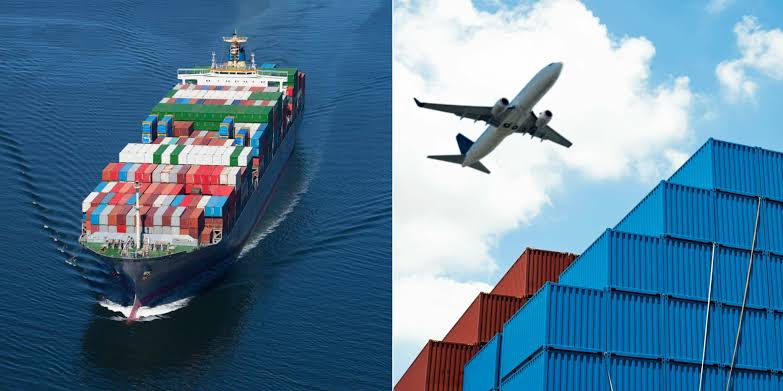
Today, the economic climate is international, and having the right shipping approach can mean the distinction between an effective and effective source chain and a productive or unprofitable one. From experienced importers to e-commerce business owners or logistics managers, the discussion on air freight versus sea freight continues. Both modes have their own unique advantages in terms of speed, cost and capacity. But if you don’t understand your cargo’s requirements, you may end up paying too much for expedited service or losing time with a slower service. This comprehensive resource provides a breakdown of the key differences between air and sea shipping and shows you how to make informed decisions on your next international shipment based on the data.
The fundamental trade-off is between speed and cost
The first difference between air and sea freight is the link between the travel time and cost. Air freight is very quick and is costly. Sea transport is slower but unmatched for large quantities due to economies of scale. This balance is very important to make sense of when planning inventory.
What are the advantages of choosing air freight?
If time really is of the essence, the only sensible option is to fly your goods. Air freight generally transports goods between continents in 1-5 days. This speed is important for perishable items (flowers, fresh food), high-dollar electronics, automotive parts and time-sensitive medical supplies. Further, air transport has also increased the security and less risk of theft or damage as there is less handling time and a stable airport environment.
Many companies work with specialized air cargo services that provide instant tracking and customs clearance, leveraging this speed in the most effective manner. For instance, a fashion brand introducing a limited-size item can’t afford to wait for 2 months to get items through ocean transportation and has to use air transportation to replenish items that sell fast in 48 hours. However, there is a catch: the cost. Air freight charges by dimensional weight (also known as chargeable weight) can make it very expensive to ship light items, but take up a lot of space.
When Sea Freight Wins for Bulk and Budget
When price per unit is the main consideration, sea freight is unbeatable. Ocean shipping offers the ability to move large amounts, from pallets to entire 40-foot containers, for a small amount of air freight. It carries about 90% of the world’s goods. Transit times vary by origin/destination and can take anywhere from 20 to 45 days – but for products such as furniture, machinery, raw materials, seasonal stock that are planned months in advance, this is fine.
If you are an exporter planning to export to the USA, it is crucial that you understand the details of sea freight from Pakistan to USA. It is normally the shipments that come from Karachi port, Long Beach or Houston or New York, and the transit time is approximately 30-40 days for the Suez route, 30-40 days for the Cape of Good Hope route. Sea freight will need to be packed with more care so as it is not affected by moisture and the pressure of being stacked on top of each other but the savings for bulk volumes is significant.
Hidden Factors That Impact Your Decision
Beyond speed and cost, several hidden variables influence whether air or sea freight is smarter for your specific shipment. These include customs procedures, environmental impact, and supply chain reliability.
Customs Clearance and Documentation
Air freight generally offers faster customs clearance because airports have dedicated cargo facilities and fewer transhipment points. However, the documentation requirements are equally strict for both modes. A missing commercial invoice or packing list can cause delays, whether your cargo is on a plane or a ship. Sea freight involves more complex terminal handling charges (THC) and port fees, but experienced freight forwarders can navigate these efficiently.
Reliability and Risk Management
Air freight is more reliable regarding schedule predictability. While ocean carriers deal with port congestion, labor strikes, and adverse weather at sea, air cargo operates on tighter, more consistent schedules. On the other hand, sea freight has a lower carbon footprint per ton-mile, making it the greener choice for environmentally conscious brands. Additionally, sea freight allows for roll-on/roll-off (RoRo) for vehicles and breakbulk for oversized machinery that cannot fit in aircraft holds.
Industry-S Scenarios – What Mode Do You Need For Your Business?
Not all products can be placed in a single category. Your choice should be informed by the type of your products, your own financial requirements and your client’s expectations.
E-commerce and Just-in-Time Manufacturing
Air freight may be the only choice for eCommerce dropshipping companies, as customers typically expect delivery within 5–10 days. Likewise, just in time (JIT) manufacturing depends on air freight to prevent production line stoppages. On the other hand, if you’re filling a warehouse for three months of sales, you need to go with sea freight. You can buy more, pay lower prices, and make up for the longer lead time by improving your forecasting.
How to Calculate Your True Shipping Cost
To make a smarter decision, compute the landed cost. Fuel surcharges, security fees, pickup/delivery – add these costs for air freight. If using sea freight, consider ocean freight, chassis charges, port charges and customs bonds. The general guideline: send out quotes for both modes if your shipment exceeds 500 kg or occupies over 2 cubic metres. In many cases, a small air delivery may be able to suffice while the remaining cargo is shipped by sea, thus providing the best of both delivery methods.
Conclusion
The final decision on air freight vs sea freight will naturally be based on your priorities. Air cargo transports are ideal for those urgent and high-value shipments that can’t wait, and when speed, security, and reliability are the most important factors, and finances are not an issue. Sea freight is the ideal mode of transport for those who are required to transport large quantities, have flexible lead times and wish to optimize their costs. For shipments looking for long-haul transportation options, such as sea freight from Pakistan to the USA, it is essential to have a forwarder who has both options and can help you find the perfect balance between inventory carrying cost and freight cost. When you assess the value, weight and shelf life of your cargo, you can put your foot firmly into the smarter foot for every shipment.
References
PES.2019. How Ai Is Transforming The Educational System. Online Available at: <https://www.professionalessayservice.co.uk/how-ai-is-transforming-the-educational-system/> (Accessed: 11 June – 2026).
Dewan, M., Murshed, M. and Lin, F., 2019. Engagement detection in online learning: a review. Smart Learning Environments, 6(1), pp.1-20