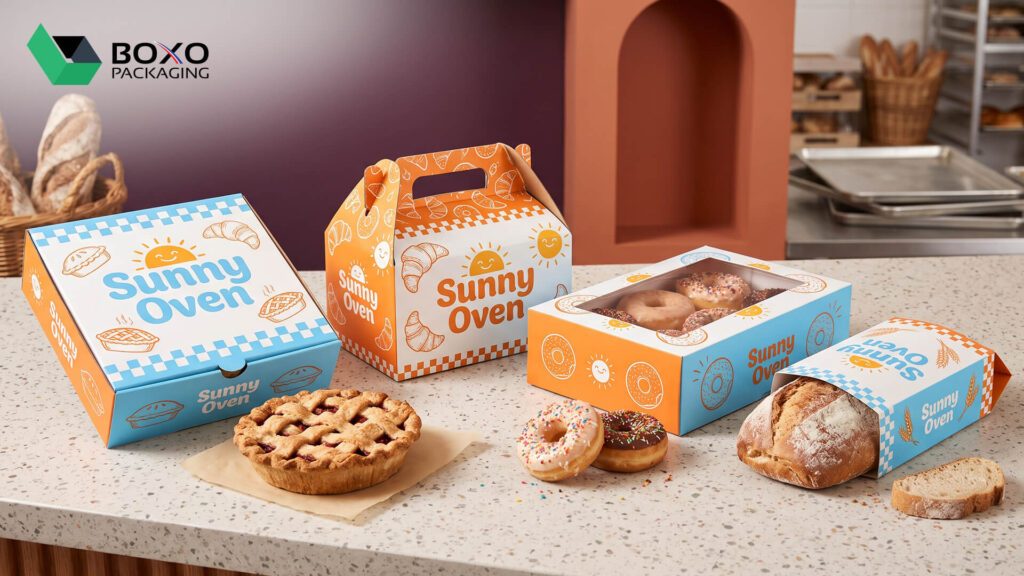
A cookie looks sturdy until it meets a box. Soft centres bend, chocolate chips melt onto the lid and a loose stack of six can arrive as a pile of crumbs. Choosing Bakery Boxes for cookies and sharing boxes means planning for softness, spread and the moment a customer opens the lid. These checks cover what to measure, test and ask before you order.
Why Cookies Spread, Stick and Break
A freshly baked cookie is flat, soft and slightly oily, and its size changes as it cools. Chocolate stays gooey for a while, so a lid that rests on the top will pull it off.
Measure several finished cookies at their widest points and note the thickest one. Write the internal dimensions in the order length, width, height so nobody reads them back to front when the order is placed. Leave a clear gap above the top layer.
Stacking, Rows and Sharing Layouts
A box of four, six or twelve needs a different layout for each count. Stacked cookies can stick together, while loose rows slide into each other.
Pack a sample for each count and tilt it gently. Greaseproof sheets between layers keep cookies apart and easy to lift out. Note which layout your team can fill fastest, because speed matters when a queue forms at the counter.
Keeping Soft Centres Soft and Crisp Edges Crisp
Trapped warmth makes crisp edges go chewy, while too much airflow dries a soft centre. Let cookies cool for different lengths of time, box them and check each after an hour.
Look at the texture and at the inside of the lid for condensation. If moisture builds up, ask your supplier about vents or a looser lid. Where boxes will touch food directly, rules differ by region, so check the current requirements for your market. This is general information, not legal advice.
Windows, Print and Grease Marks
A window shows off the cookies, but a large cut-out weakens the lid. Press gently around the opening to see how firm it feels.
Ask for a printed sample and leave a filled box in a warm room for an hour, then check the base for oil marks. Wipe the print with a dry cloth, then a barely damp one, to see whether the ink marks. Avoid printing material or safety claims unless your supplier can show you evidence you can verify.
Four Details to Confirm Before You Request a Quote
Send these together and your quote will be quicker and easier to compare:
- The internal length, width and height, measured around your thickest cookie
- The pack counts you sell, such as four, six or twelve
- The window, liner or divider style you prefer, plus print colours and finishes
- Your first order quantity and the weekly volumes you expect to reorder
Trying Real Cookies Before Production Begins
A flat drawing cannot show how a warm cookie behaves in a closed carton. At Boxo Packaging, the process starts with you sending over your product, so the fit is judged against the real item. You then request samples, test them at your own counter and with your own recipes, and review the fit, print and structure together. Production begins only once you are satisfied, which makes it easier to settle on Bakery Boxes that suit your menu.
Good cookie boxes come from honest measuring, clear space above the topping and a sample that has met real chocolate, real warmth and a real queue. Boxo Packaging supports that careful, sample-first approach, so every cookie arrives looking as tempting as it did fresh from the oven.
Custom Packaging That Cuts Wasted Space and Postage Costs
Open a parcel that is half empty and you can see the money that went into the air. Oversized cartons raise postage, need extra filler and let products slide about. Reviewing Custom Packaging with right-sizing in mind helps you pay only for the space your product needs. These checks cover what to measure, weigh and ask before you order.
Where Wasted Space Usually Comes From
Most oversized boxes start with a “close enough” decision. A standard size is picked from a catalogue, and the gap is filled with paper or air pillows to make it work.
Pick up a recent parcel from your own stock and measure how much empty space surrounds the product. If you can fit a hand beside it, the box is too large. That gap costs you in carriage, filler and the odd breakage when contents shift.
Measuring the Product and Its Fillers Together
Measuring the product alone gives a number that is rarely useful. Tissue, inserts, cards and leaflets all take up room, and soft items spring back once released.
Pack one finished order exactly as it would be sent, then measure its longest, widest and tallest points. Write the internal dimensions in the order length, width, height so nobody reads them back to front when the order is placed. Repeat this for your smallest and largest items.
Weighing Parcels and Checking Postage Bands
Courier and postal services price by size, weight or both. A box that is a few centimetres too deep can push a parcel into a more expensive band.
Weigh a fully packed sample and measure its outer dimensions, then compare the result with the current limits of the services you use. Confirm those limits with your courier, because they change. If you rely on letterbox delivery, check the packed depth carefully.
Grouping Products Into a Few Sensible Sizes
A different box for every product sounds neat but fills a storeroom. A better approach is to sort items into a few size groups, so each group shares one carton.
Lay your products out and look for natural clusters. Fill a sample with the smallest item in each group and shake it gently. If it rattles badly, add an insert or choose a smaller size for that item. Where boxes will hold food, cosmetics or other regulated goods, rules differ by region, so check the current requirements for your market. This is general information, not legal advice.
Four Details to Confirm Before You Request a Quote
Send these together and your quote will be quicker and easier to compare:
- The internal length, width and height of each size group, measured with fillers in place
- The board strength needed for the heaviest product in each group
- The print colours, finishes and where the artwork should sit
- Your first order quantity for each size, plus the reorder volumes you expect
Letting Real Parcels Settle the Sizing
A catalogue measurement cannot tell you how your own product behaves once it is packed. At Boxo Packaging, the process starts with you sending over your items, so the fit is judged against the real products. You then request samples, test them with your own filler and posting routine, and review the size, strength and print together. Production begins only once you are satisfied, which makes it easier to settle on Custom Packaging that fits snugly.
Right-sized boxes come from honest measuring, a weighed sample and a few well-chosen size groups. Boxo Packaging supports that careful, sample-first approach, so you stop paying for empty space and your customers open a parcel that looks considered.