Financial applications depend on accurate and timely market data. Whether a developer is building a currency converter, trading dashboard, investment platform, financial website, or market analysis tool, the quality of the data can affect the entire application. This makes choosing the right data provider an important part of the development process.
A Forex API gives developers a way to connect their applications with foreign exchange market data. Instead of collecting currency prices manually, developers can use API endpoints to retrieve exchange rates, currency pairs, historical information, and other financial data.
However, not every Forex API provides the same features, speed, coverage, or integration experience. integrating a Forex API requires developers to consider what their application needs today and what it may need as it grows.
What Is a Forex API?
How Forex APIs Work
A Forex API is a software interface that allows an application to request foreign exchange data from a data provider. The application sends a request to an API endpoint, and the service returns the requested information in a structured format.
For example, a developer building a currency converter may need the latest USD/EUR exchange rate. Instead of storing the rate manually, the application can request the latest available data from a Forex API and use that information for the conversion.
This process can be automated, allowing websites and applications to retrieve updated financial information without manual updates.
Why Developers Use Forex APIs
Developers use Forex APIs because financial data can be difficult to collect, organize, and maintain independently. An API provides a ready-made connection between an application and a financial data source.
This can save development time and make it easier to add financial features. A developer can focus on building the application’s interface and functionality while the API handles the delivery of market data.
What Makes a Forex API Useful for Developers?
Real-Time Exchange Rate Data
One of the most important features of a Forex API is access to current exchange rate information. Currency prices can change throughout the trading day because of economic announcements, market activity, interest-rate decisions, and other events.
For applications that display current market information, outdated data may reduce the usefulness of the platform. A Forex API that provides timely data can help developers create applications that reflect current market conditions.
Real-time or frequently updated data can be useful for currency converters, financial dashboards, market-monitoring tools, and other applications that depend on current exchange rates.
Wide Currency Pair Coverage
Developers may need more than a few major currency pairs. Depending on the application, users may want to view different combinations of global currencies.
When Choosing a Forex API, developers should check which currencies and currency pairs are supported. This is especially important for applications targeting users across multiple countries.
A wider range of supported currency data can also make it easier to expand an application in the future without changing the underlying data provider.
Historical Forex Data
Current prices are useful, but financial applications often need historical information as well. Historical Forex data can be used to create charts, study previous market movements, compare exchange rates, and develop analytical features.
For example, a developer could create a chart showing how a currency pair changed over a specific period. The application would need access to historical price information to provide this feature.
An API that offers both current and historical data can therefore support a wider range of financial applications.
Forex API Features Developers Should Consider
Simple API Documentation
Good documentation can make the integration process much easier. Developers need to understand how API endpoints work, which parameters are required, how requests should be structured, and what type of response they will receive.
Clear documentation can reduce development time and make troubleshooting easier. Before selecting a provider, developers should review the documentation and check whether it includes practical examples.
Flexible Data Access
Different applications need different types of financial information. A developer may only need current exchange rates for one project but require historical data, multiple currency pairs, and additional market information for another.
A flexible Forex API can give developers more options when building and expanding their applications.
Reliable API Performance
An application can depend heavily on its API. If the API is slow or unavailable, features that depend on financial data may not work as expected.
For this reason, developers should consider API performance and reliability when Choosing a Forex API. A dependable connection can help applications retrieve the information they need when users request it.
Scalable API Access
An application may start with a small number of users and grow over time. The API should therefore be able to support increasing data requirements.
Developers should understand request limits, available plans, and usage conditions before integrating an API. This can help prevent unexpected limitations when application traffic increases.
How Developers Can Use a Forex API
Building Currency Converters
Currency converters are a common example of an application that can use Forex API data. A user selects a base currency and a target currency, enters an amount, and receives a converted value.
The application needs exchange-rate data to perform the calculation. By connecting to a Forex API, developers can automate the process and update the information as new data becomes available.
Creating Financial Dashboards
Financial dashboards can display several currency pairs in one interface. Users may want to monitor exchange rates, price changes, charts, and other market information.
Developers can use Forex API data to populate these dashboards and organize financial information in a way that is easy to understand.
A dashboard can also combine Forex information with other financial markets. For example, an investment platform may display currency prices alongside stock, cryptocurrency, commodity, or index data.
Developing Market Analysis Tools
Forex data can also be used in market analysis applications. Developers can combine current and historical data with charts and other financial information to create tools for studying market trends.
The exact features depend on the application’s purpose, but reliable market data provides an important foundation for these tools.
Why FCS API Can Be Useful for Financial Applications
Financial Data Across Multiple Markets
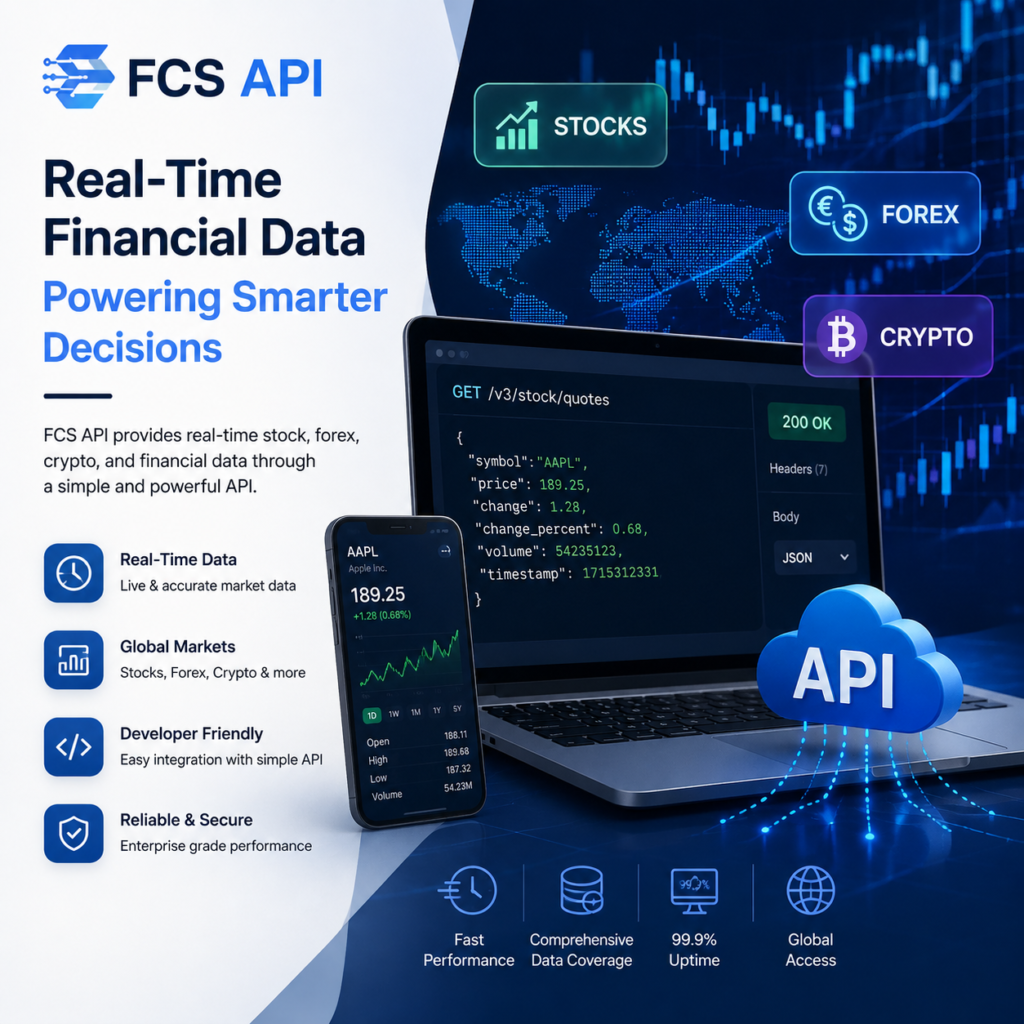
FCS API is a financial information platform that provides real-time market data, news, and analysis for global financial markets. Its coverage includes Forex, cryptocurrencies, stocks, commodities, ETFs, and indices.
This broader market coverage can be useful for developers building applications that need information from more than one asset class. Instead of designing a platform around a single type of financial data, developers can work with information across several markets.
Charts and Market Information
Financial applications often need more than raw price data. Users may also want charts, market updates, economic information, and other resources that help them understand market movements.
FCS API provides charts, economic updates, news, and educational content alongside financial market data. These resources can support applications designed to help users monitor prices and study market trends.
Choosing a Forex API for Your Application
Identify Your Data Requirements
The first step in Choosing a Forex API is understanding what your application actually needs.
A basic currency converter may only require current exchange rates. A financial dashboard may need multiple currency pairs, historical data, charts, and frequent updates. A larger financial platform may require data from Forex, stocks, cryptocurrencies, commodities, ETFs, and indices.
Defining these requirements first makes it easier to compare different API providers.
Compare Data Quality and Updates
Developers should look at how frequently the API updates its data and how the provider delivers that information. For applications that depend on current market conditions, data freshness can be especially important.
It is also useful to consider the consistency and reliability of the information across different currency pairs.
Check Integration Requirements
Before committing to an API, developers should review its technical requirements. Look at authentication methods, endpoints, response formats, documentation, request limits, and supported programming environments.
An API may provide excellent financial data, but complicated integration can increase development time. A service with clear documentation and a straightforward integration process can make development easier.
Common Mistakes When Choosing a Forex API
Focusing Only on Price
Cost is an important consideration, but it should not be the only factor. A cheaper API may not provide the update frequency, currency coverage, reliability, or features required by an application.
Developers should compare the overall value of the service against the application’s requirements.
Ignoring Future Requirements
Another common mistake is choosing an API based only on current needs. An application may eventually require additional currency pairs, historical data, or information from other financial markets.
Considering future requirements can help developers avoid replacing their data provider later.
Not Checking API Limits
API request limits can become important as an application grows. Developers should understand how many requests their application can make and whether the available plan can support expected usage.
Checking these limits before integration can help prevent technical problems later.
Final Considerations for Developers
A Forex API can provide the foundation for many financial applications, from simple currency converters to advanced market dashboards. The best choice depends on the application’s requirements, data needs, technical structure, and expected growth.
When Choosing a Forex API, developers should look beyond a simple list of features. Real-time data, currency coverage, historical information, documentation, reliability, scalability, API limits, and integration requirements all deserve attention.