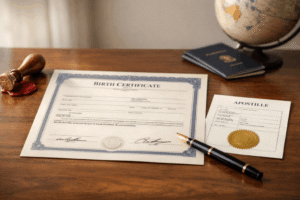
A birth certificate is one of the most important personal documents required for identity verification, immigration, family visa applications, and other legal formalities abroad. When an Indian birth certificate needs to be submitted to a foreign government department or institution, the document may require apostille authentication before it can be accepted.
A Birth Certificate Apostille verifies the authenticity of the official signature and seal on an Indian birth certificate for use in countries that are members of the Hague Apostille Convention.
Whether you are applying for a dependent visa, overseas citizenship, higher education, or permanent residency, understanding the apostille procedure can help you prepare your documents correctly.
Why Do Foreign Authorities Ask for an Apostilled Birth Certificate?
Foreign authorities often require an authenticated birth certificate to establish a person’s identity, date of birth, place of birth, and family relationships.
An apostilled birth certificate may be requested for:
-
Applying for dependent or family visas.
-
Overseas immigration and permanent residency.
-
Citizenship and nationality applications.
-
International school or university admissions.
-
Marriage registration in another country.
-
Passport and identity-related procedures.
-
Establishing parent-child relationships for legal purposes.
The exact requirements depend on the country and the authority requesting the document.
How Does Birth Certificate Apostille Work in India?
The apostille process involves checking the document and completing the required authentication before it is submitted to the Ministry of External Affairs.
Here is a general overview of the procedure.
1. Check Your Birth Certificate
Start by checking whether your birth certificate is an original government-issued document or an acceptable officially issued copy. Make sure the name, date of birth, registration details, and issuing authority information are clearly visible.
If the certificate is damaged, unclear, or contains incorrect information, you may need to obtain a corrected or fresh copy before proceeding.
2. Complete State-Level Verification
Depending on the issuing state and applicable procedure, the birth certificate may need authentication from the concerned State Home Department or another designated authority.
This stage helps establish the authenticity of the document before MEA submission.
3. Submit the Document for MEA Apostille
After completing the required preliminary authentication, the birth certificate is submitted through an authorised channel to the Ministry of External Affairs (MEA), Government of India.
The MEA verifies the relevant signature or seal and attaches the apostille sticker to the document after successful processing.
4. Receive Your Apostilled Birth Certificate
Once the apostille procedure is completed, the document is returned to the applicant. You can then submit it to the foreign authority requesting your birth certificate.
Documents Required for Birth Certificate Apostille
Before starting the process, applicants should generally prepare:
-
Original government-issued birth certificate or acceptable official copy.
-
Passport copy of the applicant.
-
Supporting identification documents, if required.
-
Additional documents requested by the concerned authority.
-
Authorisation letter, where applicable.
Requirements may vary depending on the state of issue and the destination country.
Can an Old Birth Certificate Be Apostilled?
Yes, an older birth certificate may be eligible for apostille if it meets the applicable document verification requirements.
However, some foreign authorities may ask for a recently issued birth certificate or a certificate containing updated registration details.
If your birth certificate is very old, damaged, handwritten, or missing important details, check the requirements before submitting it for authentication.
Birth Certificate Apostille for Children and Dependent Visas
Birth certificates are frequently requested when parents apply for dependent visas or relocate abroad with their children.
An apostilled birth certificate can help establish the relationship between parents and children when submitting documents to foreign authorities.
It may also be required for:
-
Child dependent visa applications.
-
Family reunification procedures.
-
Overseas school admissions.
-
Citizenship applications for children.
-
Legal guardianship and family documentation.
Some countries may additionally request an official translation of the apostilled certificate.
Which Countries Accept Birth Certificate Apostille?
Countries that are members of the Hague Apostille Convention generally recognise apostilled public documents issued by other member countries, subject to applicable requirements.
Some popular destinations include:
-
Germany
-
France
-
Italy
-
Spain
-
Netherlands
-
Australia
-
New Zealand
-
Japan
-
South Korea
-
Portugal
For countries that are not covered by the Apostille Convention, traditional embassy or consular legalisation may be required instead.
Always confirm the latest document requirements with the receiving authority.
How Long Does Birth Certificate Apostille Take in India?
The processing time depends on several factors, including:
-
State-level verification requirements.
-
Issuing authority and document format.
-
Availability of supporting documents.
-
MEA processing requirements.
-
Any additional authentication requested.
Applicants should plan ahead, particularly when the birth certificate is needed for an upcoming visa appointment, university admission, or immigration application.