Selecting an engagement ring is the straightforward part. Finding a wedding band that sits flush beside the engagement ring, still looks right in ten years, and can withstand your actual life is the real challenge. That’s where most people come unstuck. Search for bridal set rings in the UK, and you’ll find matched pairs designed together, which removes plenty of guesswork. What it doesn’t remove is the need to think about your hands, your job and your taste, though.
Below, we cover what a bridal set is, how to match metals, profiles and stones, what holds up to daily wear, and whether an eternity ring belongs in the mix.
What Is a Bridal Set, And Is It Better Than Buying Separately?
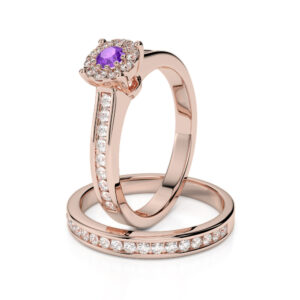
A bridal set is an engagement ring and wedding band designed to be worn together, usually sharing the same metal, stone style and proportions. It suits anyone who wants a guaranteed fit and a cohesive look. Buying separately gives more freedom, but you carry the risk of gaps, clashing heights and mismatched colours.
Most of the advantage comes down to geometry. An engagement ring with raised claws or a halo of small diamonds often needs a band with a gentle curve, or the two rings leave a visible gap that snags on knitwear. A matched pair has that curve built in. A random plain band usually doesn’t.
Why designed-together pairs sit better
Whoever designs a pair has already tested how the band meets the setting. The metal tones are consistent too, which matters more than people expect. A yellow gold band beside a white gold ring can look like an accident rather than a choice.
That said, a set isn’t automatically the best route. If you already own an engagement ring, perhaps a family piece, you’re matching to something fixed, and an exact twin may not exist.
Worn together, apart or soldered
Sets give you options. Plenty of people wear both rings daily, then slip the engagement ring off for the gym, gardening or a messy bit of DIY and keep the band on. Others have the two rings joined by a jeweller so they don’t spin or shuffle against each other.
Joining has a catch. Soldered rings are harder to resize and harder to clean between the bands, so think twice if your fingers tend to change size.
How Do You Match an Engagement Ring and a Wedding Band?

Match three things: metal, profile and visual weight. Keep the metal identical or deliberately contrasting, make sure the band’s shape clears the engagement ring’s setting, and choose a width that balances the centre stone. Sparkle and colour come last. Most mismatches happen because people start with the sparkle and end with a gap.
Even with bridal set rings UK jewellers sell as matched pairs, try both on together before you commit. Photographs flatten everything. A band that looks snug online can sit proud of the engagement ring in real life, and you’d rather learn that in a Hatton Garden showroom or Birmingham’s Jewellery Quarter than after the wedding.
Metal and colour
White metals aren’t all the same. Platinum has a naturally silvery-white tone that remains constant, while white gold is typically coated with a thin layer of rhodium that can wear off over time and requires periodic reapplication. Yellow and rose gold hide fine scratches more kindly, which suits anyone who’s tough on their hands.
Although, a perfect matching is overrated. The wedding band takes more knocks than the engagement ring because it’s worn constantly, so the two age differently anyway. A band in the same metal but a different finish, say satin, against a polished ring, can look more deliberate than an exact copy.
Profile and fit
Profile means the band’s cross-section. A court profile, softly rounded inside and out, is the comfortable default. Flatter profiles look more modern but can feel tighter on the finger.
A shaped or contoured band curves around the engagement ring’s setting, while a straight band suits low, flush settings. Width matters as well. Wider bands generally feel snugger, so anything over about 4mm may need a slightly larger size than your engagement ring.
The classic error? Buying the band before the engagement ring is finalised, or sizing the two in isolation, is a common mistake.
Stones and style
Let the two rings talk to each other. A diamond-set band can echo a halo, while a plain band calms an ornate setting. If the centre stone is coloured, such as a ruby or blue sapphire, a diamond-set band lets the colour lead without competing with it.
Which Ring Choices Stand Up to Everyday Wear?
Hardness, metal and setting style decide durability. Diamond scores 10 on the Mohs scale, while emerald sits around 7.5 to 8, so diamonds take knocks better. Platinum tends to scratch and develop a soft patina rather than lose much metal. A protective setting often matters more than the stone itself.
Gemstones: diamond versus emerald
On a Mohr’s scale. Emeralds range from 7.5 to 8 and most emeralds contain natural inclusions and are commonly treated with oils to improve clarity. Hardness isn’t the same as toughness, though. An emerald can chip on a sharp knock even if it resists scratching.
So are emerald eternity rings a bad idea for daily wear? Not at all, but they reward a gentler routine. Desk work, the commute and dinner out are fine. Weight training, climbing and wrestling a pushchair onto a bus are less kind.
Metals: platinum and gold
Carat describes gold purity in 24 parts. That makes 18 ct of 75% pure gold and 9 ct of 37.5%. Higher carat gives a richer colour but a softer metal, while lower carat is harder wearing and paler. Platinum 950 means 950 parts per thousand are pure platinum, or 95%, and it feels noticeably heavier on the hand.
That density is why platinum diamond eternity rings appeal to people who want a white metal with no replating and who don’t mind a little extra weight. They’re usually the more expensive route, so it’s a trade-off rather than a free upgrade.
Settings that protect
A claw setting lets in the most light but leaves stones standing proud. Channel and rub over settings sink stones into the metal, so they snag less and survive knocks better. Pavé, where tiny stones are beaded closely together, looks glittery but asks for the occasional check-up.
Whatever you pick, take rings off for heavy cleaning and chlorinated pools. Both are tougher on jewellery than most people realise.
Should You Add an Eternity Ring to Your Set?
An eternity ring is a band set with stones around all or part of the circle. It can sit beside the wedding band as a third ring or replace a plain band altogether. Often, it’s a lovely addition, but it isn’t essential, so weigh up comfort, sizing and how much sparkle you want every day.
Full or half eternity?
Diamond full eternity rings carry stones around the entire band, so they look identical however they rotate on your finger. The catch is that stones all the way round make resizing difficult, and the underside can rub if you grip things a lot.
A half eternity ring has a plain underside. It’s easier to resize, usually more comfortable and sits flatter against the palm. If you type all day or lift weights, I’d lean that way.
Adding colour and keeping metals consistent
Emerald eternity rings bring a green accent that looks striking beside a diamond engagement ring. They’re also a thoughtful gift for anyone born in May, as emerald is the May birthstone.
For a calmer look, platinum eternity rings with diamonds pair neatly with a platinum or white gold set, as the metals blend into one bright line. Stacking order is personal, but traditionally, the wedding band sits closest to the hand, followed by the engagement ring, and then the eternity ring, which can be placed either beyond the engagement ring or on the other side.
Frequently Asked Questions
-
Should the wedding band touch the engagement ring?
Ideally, it should sit snugly against it, with no wedge-shaped gap. A contoured band is built to do that. If your engagement ring has a tall setting, a small gap can be normal with a straight band, so check how both look from the side and the top before buying.
-
Can I mix yellow gold and white metals?
Yes, and it’s increasingly common. The trick is making the contrast look deliberate. Pair a yellow gold band with a white metal engagement ring of similar width and finish, and keep the stones the same colour so the combination feels planned rather than accidental.
-
How do I get the right size for stacked rings?
UK sizes are run by letter, such as L or N, and fingers swell with heat and activity. Get measured in the afternoon, wear the rings together when trying them, and allow for width. This guideline is particularly important for diamond full eternity rings, as the stones encircling the band restrict the possibility of resizing later on.
-
Is a bridal set practical for an active lifestyle?
It can be. Choose low, protective settings such as channel or rub over, a court-profile band and a tougher stone like diamond. Take the rings off for lifting weights, climbing or heavy cleaning, and store them somewhere safe rather than in a gym bag pocket.
Summing up
To sum up, the best bridal set rings UK couples can buy are the ones that fit the life they actually live. Matching comes down to metal, profile and weight, not identical sparkle. Diamond is the hardest-wearing stone, emerald asks for more care, and platinum and gold trade colour, weight and upkeep in different ways. An eternity ring can finish the stack beautifully, provided you’re realistic about comfort and sizing. Pick the pair you’ll still reach for on an ordinary Tuesday.