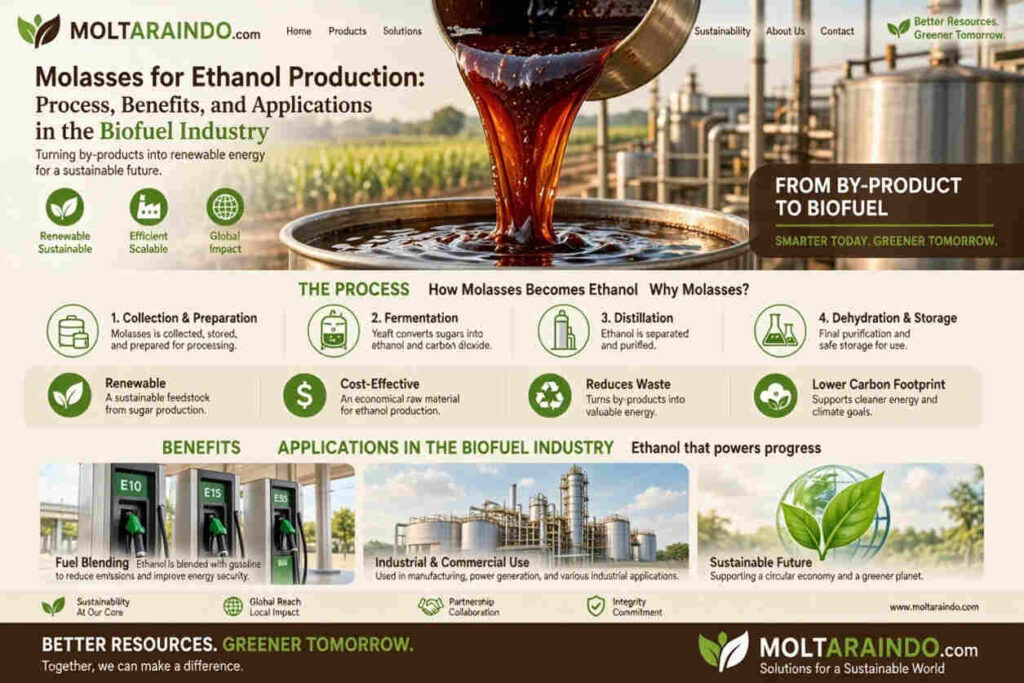
Molasses for Ethanol Production: Process, Benefits, and Applications in the Biofuel Industry – The growing demand for renewable energy has encouraged industries worldwide to explore alternative raw materials for biofuel manufacturing. One important agricultural byproduct gaining attention is molasses, particularly sugarcane molasses. Rich in fermentable sugars, this thick, dark liquid provides a valuable resource for producing ethanol through microbial fermentation. As countries seek to reduce their dependence on fossil fuels, molasses has become an attractive feedstock for the bioethanol industry.
Molasses is widely available in sugar-producing regions, including Indonesia, Brazil, India, and Thailand. Its relatively high sugar content, established supply chains, and suitability for industrial fermentation make it a practical option for ethanol manufacturers. Understanding how molasses is converted into ethanol helps explain its importance in the renewable energy sector.
What Is Molasses and Why Is It Used for Ethanol Production?
Molasses is a thick syrup produced during the sugar manufacturing process. It is obtained after sugarcane juice or sugar beet juice undergoes extraction, clarification, concentration, and crystallization. During repeated crystallization, some sugars remain in the residual syrup, creating molasses.
Sugarcane molasses contains several important components, including sucrose, glucose, fructose, minerals, organic compounds, and water. These sugars provide the carbon source required by yeast during fermentation.
Molasses is particularly suitable for ethanol production because it offers several advantages:
- High fermentable sugar content: Provides the raw material needed for alcohol fermentation.
- Agricultural availability: Can be sourced from established sugar production industries.
- Cost efficiency: Utilizes a byproduct rather than relying entirely on food-grade sugar.
- Industrial compatibility: Can be processed using conventional fermentation equipment.
- Resource efficiency: Supports the utilization of agricultural residues and improves the value of sugar manufacturing byproducts.
These characteristics make molasses an important feedstock for industrial ethanol and bioethanol production.
The Ethanol Production Process Using Molasses
Producing ethanol from molasses involves several stages, from raw material preparation to alcohol recovery. Each stage contributes to fermentation efficiency, product quality, and overall production performance.
1. Molasses Preparation and Dilution
The first stage involves preparing molasses for fermentation. Because commercial molasses is highly concentrated and viscous, it must be diluted with water to achieve an appropriate sugar concentration.
The dilution process also makes the material easier to handle and allows microorganisms to access fermentable sugars. Manufacturers typically evaluate Brix levels, total fermentable sugars, pH, and other relevant parameters before preparing the fermentation medium.
2. Nutrient Adjustment and Treatment
Although molasses naturally contains minerals and other nutrients, its composition can vary depending on the sugarcane variety, processing conditions, and storage practices.
The fermentation medium may require nutrient supplementation to support healthy yeast growth. Nitrogen, phosphorus, and other essential nutrients can be adjusted according to the production requirements.
Depending on the raw material quality, manufacturers may also apply clarification or treatment procedures to reduce suspended solids and unwanted substances.
3. Yeast Fermentation
Fermentation is the central stage of ethanol production. Yeast, commonly Saccharomyces cerevisiae, converts fermentable sugars into ethanol and carbon dioxide under controlled conditions.
The simplified chemical reaction is:
C6H12O6 → 2C2H5OH + 2CO2
During this process, glucose and fructose are converted into ethanol. Sucrose is first broken down into simpler sugars before fermentation.
Temperature, pH, yeast concentration, sugar availability, and fermentation time must be carefully controlled. Proper management helps maximize ethanol yield while minimizing unwanted byproducts.
4. Distillation
After fermentation, the resulting liquid, commonly called fermented wash or beer, contains ethanol, water, residual sugars, yeast, and other compounds.
Distillation separates ethanol from most of the water and nonvolatile materials. Industrial facilities use distillation columns to concentrate the alcohol to the required strength.
5. Dehydration and Final Processing
For applications requiring fuel-grade ethanol, additional dehydration is necessary to remove most remaining water. Technologies such as molecular sieves are commonly used to produce anhydrous ethanol.
The final product undergoes quality testing to ensure that it meets the relevant specifications for its intended application.
Benefits of Using Molasses for Ethanol Manufacturing
Molasses offers several economic and environmental advantages for biofuel manufacturers.
1. Cost-Effective Raw Material
Molasses is a residual product of sugar production. Its availability can provide ethanol manufacturers with a competitive feedstock option, particularly in regions with established sugar industries.
2. Supports Renewable Energy Development
Ethanol produced from sugarcane molasses is a bio-based fuel that can help diversify energy sources. When produced with effective resource and energy management, it can contribute to lower lifecycle greenhouse gas emissions compared with conventional fossil fuels.
3. Adds Value to Sugar Industry Byproducts
Instead of treating molasses solely as a secondary product, sugar manufacturers can supply it to fermentation industries. This creates additional commercial opportunities and strengthens the agricultural value chain.
4. Established Industrial Technology
Molasses fermentation uses well-established industrial processes. This allows manufacturers to apply proven technologies and production systems while improving efficiency through process optimization.
5. Supports Agricultural Economies
The demand for fermentation-grade molasses can create additional markets for sugar producers, agricultural processors, exporters, and logistics companies.
Applications of Molasses-Based Ethanol in the Biofuel Industry
Ethanol produced from molasses serves several important purposes in modern energy and industrial markets.
One major application is gasoline blending. Bioethanol can be blended with conventional gasoline in different proportions, depending on national fuel standards and vehicle compatibility. This helps diversify transportation fuel supplies.
Molasses-based ethanol also supports the production of higher ethanol blends where suitable infrastructure and regulations are available. In addition, ethanol can serve as a feedstock for other industrial chemicals and bio-based products.
Beyond transportation, industrial ethanol is used in selected manufacturing, pharmaceutical, chemical, and solvent applications, subject to the required purity and regulatory specifications.
Choosing Quality Molasses for Ethanol Production
Raw material quality directly influences fermentation performance. Therefore, ethanol manufacturers should evaluate several important characteristics when selecting a molasses supplier.
These include Brix concentration, fermentable sugar content, total reducing sugars, pH, ash content, viscosity, and the presence of unwanted contaminants. Consistent specifications are particularly important for large-scale facilities that require stable production conditions.
Reliable supply capacity, proper storage, transportation arrangements, and batch documentation are also essential considerations. Working with an experienced supplier helps manufacturers maintain continuity and reduce potential disruptions in their production operations.
Conclusion
Molasses plays an important role in the development of the bioethanol industry because of its fermentable sugar content, agricultural availability, and compatibility with established fermentation technologies. Through preparation, yeast fermentation, distillation, and dehydration, sugarcane molasses can be transformed into ethanol for fuel blending and various industrial applications.
moltaraindo – As renewable energy demand continues to expand, quality fermentation-grade molasses will remain an important raw material for ethanol manufacturers. Reliable sourcing and consistent product specifications can help support efficient production while creating additional value for the global sugar and biofuel industries.