Inventory management has always been a balancing act. Businesses must ensure that products are available when customers need them while avoiding excess inventory that ties up capital and increases storage costs. Achieving this balance becomes even more challenging in today’s dynamic retail environment, where demand patterns are constantly changing.
Traditional inventory management methods often rely on historical data and fixed rules. While these approaches provide a baseline, they are not equipped to handle real-time fluctuations in demand. This is where predictive replenishment tools are transforming the landscape.
By leveraging data, analytics, and artificial intelligence, predictive replenishment tools enable businesses to anticipate demand more accurately and optimize inventory levels. The result is a more efficient system that reduces stockouts without creating unnecessary overstock.
What are Predictive Replenishment Tools?
Predictive replenishment tools are systems that use advanced analytics and machine learning to forecast demand and automate replenishment decisions. They analyze multiple data sources to determine when and how much inventory should be restocked.
These tools go beyond traditional forecasting by incorporating real-time signals and continuously learning from new data. This allows them to adapt to changing conditions and improve accuracy over time.
The Problem with Traditional Inventory Management
Traditional replenishment strategies are often reactive. Businesses monitor inventory levels and reorder products when stock falls below a certain threshold.
This approach has several limitations:
- Delayed response to demand changes
- Over-reliance on historical data
- Inability to account for external factors
- Higher risk of stockouts and overstocking
For example, a sudden increase in demand during a promotional event may not be captured in historical data, leading to stock shortages. Similarly, overestimating demand can result in excess inventory that is difficult to sell.
How Predictive Replenishment Tools Work
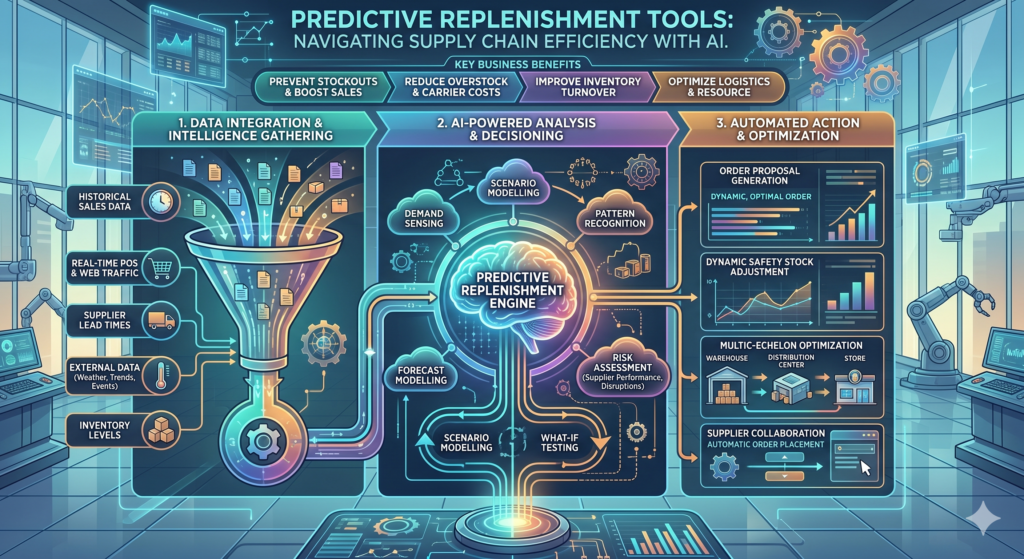
Predictive replenishment tools use a combination of data, algorithms, and automation to improve decision-making.
Data Integration
These tools collect data from various sources, including:
- Historical sales data
- Real-time transaction data
- Inventory levels
- Supplier lead times
- Customer behavior
- External factors such as seasonality and promotions
This comprehensive dataset provides a more accurate view of demand drivers.
Demand Forecasting
Machine learning models analyze data to identify patterns and predict future demand. These models continuously improve as new data becomes available.
Demand Sensing
Real-time data allows the system to detect changes in demand as they happen. This enables businesses to adjust forecasts dynamically.
Replenishment Optimization
The system determines the optimal quantity and timing for replenishment orders, balancing availability with cost efficiency.
Automation
Replenishment decisions can be automated, reducing manual effort and improving speed and accuracy.
Benefits of Predictive Replenishment Tools
Reduced Stockouts
By anticipating demand, businesses can ensure that products are available when customers need them, minimizing lost sales.
Lower Inventory Costs
Optimized inventory levels reduce storage and holding costs.
Improved Cash Flow
Avoiding excess inventory frees up capital for other business activities.
Better Customer Experience
Consistent product availability leads to higher satisfaction and loyalty.
Increased Operational Efficiency
Automation streamlines processes and reduces manual intervention.
Key Use Cases
High-Demand Retail Environments
Predictive tools help retailers manage inventory during peak seasons and promotional events.
Multi-Location Inventory Management
Businesses can optimize inventory distribution across warehouses and stores.
Perishable Goods Management
For industries such as grocery, predictive replenishment helps balance freshness with minimizing waste.
Ecommerce Operations
Online retailers can align inventory with real-time demand signals from website activity.
The Role of Real-Time Data
Real-time data is a critical component of predictive replenishment. It allows businesses to respond quickly to changes in demand.
For example, a surge in product searches or page views can indicate rising interest. Predictive tools can use this information to adjust forecasts and trigger replenishment actions.
This responsiveness is what enables businesses to stay ahead of demand.
How AI Enhances Predictive Replenishment
Artificial intelligence is at the core of predictive replenishment tools. It enables:
- Identification of complex demand patterns
- Continuous improvement of forecasts
- Automation of decision-making
- Faster response to market changes
AI-driven systems can process large volumes of data and deliver insights that would be difficult to achieve manually.
Challenges in Implementation
Data Quality
Inaccurate or incomplete data can reduce the effectiveness of predictive models.
Integration Complexity
Combining data from multiple systems requires strong integration capabilities.
Change Management
Adopting new tools and processes may require organizational adjustments.
Model Maintenance
Predictive models need continuous monitoring and refinement.
Addressing these challenges is essential for successful implementation.
Best Practices for Adoption
Build a Strong Data Foundation
Ensure that data is accurate, consistent, and integrated across systems.
Start with High-Impact Areas
Focus on products or categories where predictive replenishment can deliver immediate value.
Leverage Automation
Automating replenishment decisions improves efficiency and scalability.
Combine Technology with Expertise
Human insights remain valuable for strategic decision-making.
Continuously Optimize
Regularly evaluate performance and refine models to improve outcomes.
The Future of Inventory Management
Inventory management is moving toward greater intelligence and automation. Predictive replenishment tools will continue to evolve, enabling businesses to operate with higher precision.
Future trends include:
- Real-time demand sensing at scale
- Integration with supplier systems
- Autonomous inventory management
- Advanced scenario planning
These advancements will allow businesses to anticipate demand more accurately and respond more effectively.
Conclusion
Predictive replenishment tools are redefining how businesses manage inventory. By leveraging data, AI, and real-time insights, they enable organizations to reduce stockouts, avoid overstocking, and improve overall efficiency.
In a competitive market, the ability to balance supply and demand is a key advantage. Businesses that adopt predictive replenishment tools will be better positioned to optimize operations, enhance customer experience, and drive sustainable growth.