used-toyota-import-cost-cyprus
Buying a used Toyota from Japan can be an attractive option for motorists in Cyprus who want a reliable vehicle, competitive pricing, and a wider choice of models. Japanese auctions offer access to compact hatchbacks, hybrid saloons, crossovers, and family SUVs in different grades, mileages, and specifications. However, the auction price is only one part of the purchase.
To make a sound decision, buyers need to evaluate the complete cost of bringing a vehicle to Cyprus, including shipping, customs duties, applicable taxes, registration, and any necessary modifications or inspections. Understanding the used Toyota import cost Cyprus buyers may face helps prevent unexpected expenses and makes comparisons with locally available vehicles more meaningful.
Why Consider a Used Toyota from Japan?
Toyota has a strong reputation for durability, practical engineering, and broad model availability. Japanese used-car auctions also provide access to vehicles with different equipment levels, production years, and mileage histories.
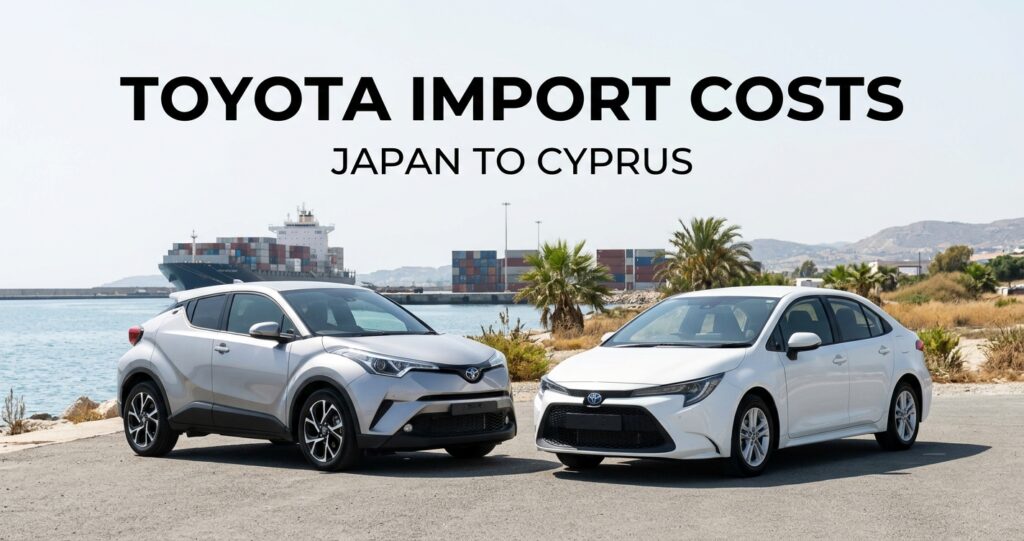
Popular choices for Cyprus buyers include the Toyota Aqua for economical urban driving, the Yaris for everyday practicality, the Corolla for comfortable family transport, the C-HR for crossover styling, and the RAV4 for additional passenger and luggage space. Hybrid versions may appeal to drivers seeking lower fuel consumption, particularly in regular city traffic.
Nevertheless, the right vehicle depends on more than its reputation. Buyers should compare the purchase price against the car’s age, condition, service history, equipment, expected maintenance, and suitability for local registration.
How to Compare Toyota Auction Prices
Toyota auction prices can vary considerably, even between vehicles of the same model year. Mileage, condition, trim level, drivetrain, auction grade, and demand all influence the final bidding price.
Compare Like-for-Like Vehicles
Start by selecting several examples of the same model with similar production years, mileage, engine specifications, and equipment. Comparing a basic petrol Yaris with a newer hybrid model, for example, may produce a misleading impression of market value.
Review the following factors before deciding on a bidding budget:
-
Model year: Newer vehicles may command higher prices but could offer updated safety features and improved efficiency.
-
Mileage: Lower mileage can be attractive, although service history and mechanical condition matter just as much.
-
Auction grade: Auction grades provide useful guidance about general condition, but grading systems and report details should be interpreted carefully.
-
Repair history: Inspection sheets may identify scratches, dents, corrosion, replaced panels, or interior wear.
-
Specifications: Safety equipment, infotainment features, transmission, and hybrid technology can influence value.
-
Market demand: Popular models and desirable variants may attract stronger bidding competition.
Read the Auction Sheet Before Bidding
An auction sheet helps buyers assess a vehicle beyond its photographs. It may include an overall grade, mileage information, damage markings, and notes about interior or exterior condition. The precise information available depends on the auction house and vehicle.
Where possible, obtain a reliable translation and have unclear markings reviewed before committing to a purchase. A low auction price is not necessarily a bargain if the car requires extensive repairs, has questionable mileage, or carries a history that affects its resale value.
Calculate a Realistic Bidding Limit
Rather than bidding according to the available budget alone, work backwards from the maximum amount the vehicle should cost once delivered and registered in Cyprus.
Subtract estimated shipping, insurance, export and handling charges, applicable taxes, customs-clearance expenses, registration fees, and a contingency for repairs or unforeseen costs. The remaining amount becomes the maximum sensible purchase budget, subject to confirmation of the actual charges.
Understanding Shipping Fees and Landed Costs
Shipping fees are a major component of the total import budget. The final amount depends on the shipping method, vehicle dimensions, departure arrangements, insurance, port charges, and any additional handling required.
RoRo vs Container Shipping
Roll-on/roll-off (RoRo) shipping is often a practical option for standard vehicles because cars are driven onto and off the vessel. Container shipping may be preferable for high-value vehicles or when additional cargo arrangements are required, although it can cost more.
When comparing shipping quotations, check whether they include:
-
Inland transport from the auction facility to the Japanese port.
-
Export documentation and handling charges.
-
Ocean freight to Cyprus.
-
Marine insurance.
-
Destination port handling and release fees.
A low freight quotation may exclude several of these expenses. Request an itemised estimate so that competing offers can be compared on equal terms.
Calculate the Customs Value Correctly
Cyprus Customs calculates the customs value using the vehicle’s purchase price and the applicable freight and insurance costs up to the point of entry. This is commonly described as the CIF value: cost, insurance, and freight.
For example, a vehicle purchased for €5,000, with €900 in freight and €100 in insurance, would have an illustrative CIF value of €6,000.
That figure provides the starting point for estimating import taxes. It does not represent the final cost of owning a registered vehicle in Cyprus.
Customs Duties and VAT in Cyprus
Customs duties and VAT can materially change the economics of importing a used Toyota. Since Japan is outside the European Union, vehicles imported from Japan must satisfy the relevant customs procedures and tax requirements.
Cyprus Customs states that imported motor vehicles are generally subject to import duty and VAT, with the applicable duty depending on the vehicle category and tariff rules. The standard VAT rate is 19%.
There is an important qualification for Japanese vehicles in 2026: the EU-Japan Economic Partnership Agreement may allow preferential customs duty treatment for vehicles that meet the applicable origin requirements. Buyers should establish whether the specific vehicle qualifies and what supporting proof is required before relying on a reduced or zero duty rate. Buying a vehicle at an auction in Japan does not, by itself, prove that it qualifies as being of Japanese preferential origin.
Using the illustrative €6,000 CIF value:
| Cost component | Example amount |
|---|---|
| Vehicle purchase | €5,000 |
| Shipping | €900 |
| Insurance | €100 |
| CIF value | €6,000 |
| Import duty at 0%, if eligible | €0 |
| VAT at 19% on €6,000 | €1,140 |
Illustrative calculation only. It excludes auction and exporter fees, customs clearance, port handling, registration, inspection, and other expenses. The actual tax treatment depends on the applicable rules and documentation.
If a 10% duty rate applied instead, the duty would be €600 and VAT on the €6,600 taxable amount would be €1,254. That would bring the combined duty and VAT to €1,854 rather than €1,140.
This difference demonstrates why checking eligibility and documentation before bidding is essential.
Registration Costs in Cyprus
Clearing customs does not automatically make a vehicle road-ready. Buyers must also confirm that the specific model can be registered and that it meets the applicable technical and administrative requirements.
Before purchasing, contact the Cyprus Department of Road Transport or a qualified local importer to verify the vehicle’s eligibility. Cyprus applies restrictions to certain vehicles imported from outside the EU, and the registration process can involve additional approval and documentation.
Budget for the relevant expenses, which may include:
-
Registration and administrative fees.
-
Single Vehicle Approval or other required technical approval.
-
Roadworthiness testing, where applicable.
-
Documentation, translations, and number plates.
-
Insurance before the car is driven on public roads.
-
Annual road tax and any required maintenance.
Registration costs Cyprus buyers face can vary with the vehicle and the procedure required. Annual road tax should also be considered when comparing ownership costs, particularly when evaluating petrol and hybrid variants with different emissions characteristics.
Japanese-market cars are generally right-hand drive, which suits Cyprus’s left-hand traffic system. However, correct steering configuration alone does not guarantee that every imported model will qualify for registration.
How to Compare Importing with Buying Locally
The best way to assess an imported Toyota is to compare its complete landed and registered cost against the price of an equivalent car already available in Cyprus.
| Comparison factor | Imported Toyota | Locally available Toyota |
|---|---|---|
| Purchase price | Auction price plus exporter fees | Advertised or negotiated price |
| Vehicle condition | Auction sheet and inspection records | Local inspection and service history |
| Transport | Japan-to-Cyprus freight and handling | Usually included in the existing vehicle’s location |
| Taxes and clearance | Import taxes and customs processing | Usually reflected in the asking price |
| Registration | May require additional approval | Check current registration status |
| After-purchase expenses | Repairs, testing, insurance and maintenance | Repairs, insurance and maintenance |
A local vehicle may cost more initially but offer immediate availability and an established local service history. An imported Toyota may offer better value or a more desirable specification, provided its additional costs do not eliminate the price advantage.
For a more detailed breakdown of the process, see Nobuko Japan’s Cars from Japan to Cyprus: How to Buy, Ship and Save Money in 2026. It covers auction sourcing, shipping, taxes, and worked cost examples for Japanese imports.
Choosing the Right Toyota for Your Budget
Different Toyota models suit different ownership priorities.
-
Toyota Aqua: Worth considering for city driving and fuel efficiency, especially for buyers who prioritise economical daily transport.
-
Toyota Yaris: A practical option for commuting, smaller parking spaces, and routine urban journeys.
-
Toyota Corolla: Suitable for buyers seeking a versatile car for commuting and family use.
-
Toyota C-HR: Appeals to drivers who want crossover styling, a higher seating position, and hybrid availability in selected variants.
-
Toyota RAV4: Offers additional cabin and luggage space for families and longer journeys.
When comparing these models, calculate expected fuel expenditure, servicing, tyres, insurance, and likely repairs alongside the initial purchase price. A hybrid may reduce fuel spending in certain driving conditions, but its age, battery condition, and maintenance history should be assessed before purchase.
Common Mistakes to Avoid When Importing
Several avoidable errors can turn an apparently inexpensive auction purchase into a costly decision.
Focusing only on the auction price. Exporter fees, inland transport, shipping, insurance, customs, and registration all affect the final bill.
Assuming every Japanese car can be registered. Confirm the age restrictions, technical approval requirements, and eligibility of the exact model with Cyprus authorities before bidding.
Overlooking origin documentation. Preferential duty treatment may depend on the vehicle’s origin and acceptable supporting documents, not simply the country from which it ships.
Underestimating condition-related expenses. Tyres, brakes, suspension, lights, and routine servicing may need attention after arrival.
Comparing different vehicle specifications. A fair comparison should account for model year, mileage, equipment, hybrid technology, and accident history rather than relying on headline prices alone.
Final Thoughts
Importing a used Toyota from Japan can be worthwhile for Cyprus buyers, but a successful purchase starts with careful calculations rather than an attractive auction listing. Compare similar vehicles, review their condition records, obtain itemised shipping quotations, verify customs treatment, and confirm registration eligibility before committing to a bid.
A thorough estimate of the used Toyota import cost Cyprus buyers will ultimately pay should include the vehicle, export and shipping expenses, insurance, customs duties, VAT, clearance, registration, inspections, and an allowance for maintenance. Comparing that total with equivalent cars on the local market will provide a much clearer picture of the potential savings.
For a practical next step, read Nobuko Japan’s used Toyota import cost guide for a closer look at import taxes and the expenses that contribute to the final cost.
Important: Import rules, duty rates, and registration requirements can change. Confirm the current requirements for your specific vehicle with Cyprus Customs and the Department of Road Transport before purchase.