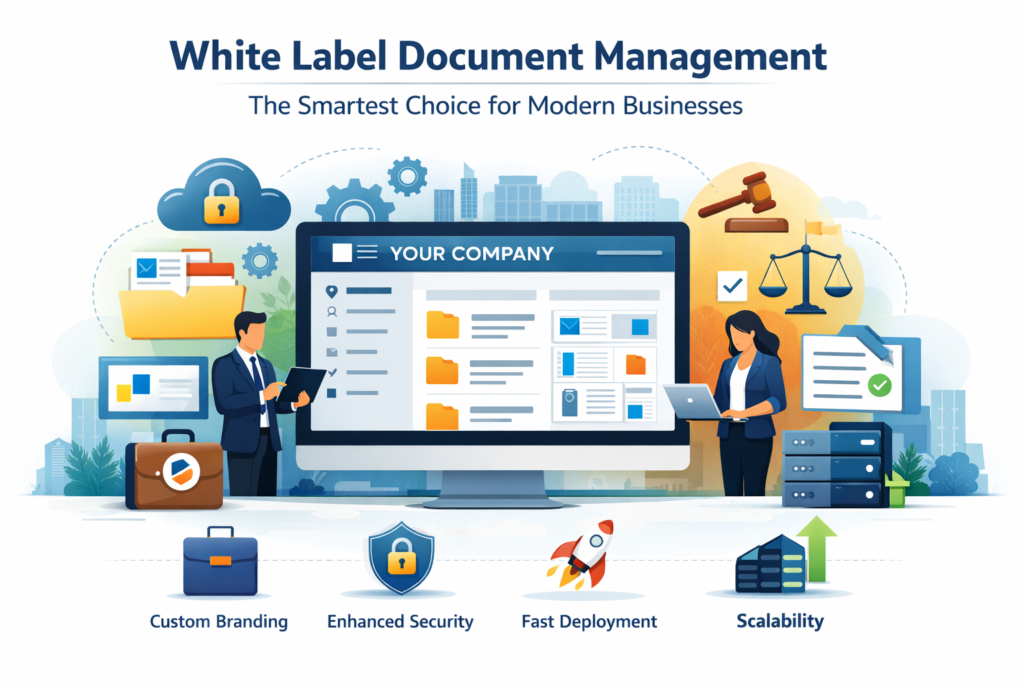
White Label Document Management
In today’s digital-first business environment, documents are no longer static files stored in cabinets or isolated servers. They are living assets that move across departments, partners, and clients. Managing them securely, efficiently, and at scale has become a strategic priority. This is where White Label Document Management emerges as a powerful solution, allowing businesses to offer advanced document handling capabilities under their own brand while avoiding the complexity and cost of building such systems from scratch. White label solutions align perfectly with modern business needs by combining speed, flexibility, and brand ownership. They enable companies to focus on growth, customer experience, and innovation instead of infrastructure maintenance.

What White Label Document Management Means for Businesses Today

White Label Document Management refers to a ready-made document management platform that can be fully rebranded and customized as a company’s own product. Instead of investing years into developing a proprietary system, businesses can deploy a proven solution that already includes document storage, version control, access permissions, collaboration tools, and compliance features. A white label document management system gives organizations control over user experience, branding, and feature configuration, while the underlying technology is maintained by the solution provider. This approach significantly reduces technical risk and accelerates time to market.

The Growing Business Challenges That Make Document Management Critical

As businesses scale, document-related challenges multiply. Teams work remotely, clients expect instant access, and regulatory requirements demand strict controls. Without a centralized system, companies face issues such as document duplication, inconsistent versions, data leaks, and inefficient approval workflows. A white label document management system addresses these challenges by offering a single source of truth for all documents. It ensures that teams always access the latest version, permissions are enforced consistently, and audit trails are automatically maintained. These capabilities are no longer optional; they are essential for operational stability.

Why White Label Document Management Is More Strategic Than Building In-House

Building a document management platform internally may seem attractive for businesses seeking full control, but the reality is far more complex. Development costs are high, maintenance is ongoing, and security updates require constant attention. Even after launch, the system must evolve to keep up with compliance standards and user expectations. White Label Document Management eliminates these burdens. Businesses gain access to enterprise-grade features immediately, backed by ongoing updates and security enhancements from the provider. This allows internal teams to focus on core competencies rather than diverting resources to long-term software maintenance.

Brand Ownership Without Technical Complexity

One of the strongest advantages of white label solutions is brand consistency. Clients and internal users interact only with the business’s branding, interface design, and domain. This reinforces trust and professionalism while keeping the technical foundation invisible. A white label document management system can be tailored to match existing workflows, user roles, and industry-specific needs. From login screens to notification emails, every touchpoint reflects the company’s identity, creating a seamless digital experience.

Enhanced Security and Compliance for Regulated Industries

Security is a non-negotiable requirement for document handling, especially in industries such as legal, finance, healthcare, and real estate. White label platforms are typically built with advanced security frameworks, including encryption, role-based access, activity logging, and secure cloud storage. For legal firms and corporate legal departments, White Label Legal Document Management Software is particularly valuable. It supports strict confidentiality requirements, matter-based document organization, and detailed audit trails. These systems are designed to align with regulatory standards and reduce the risk of compliance violations.

Faster Time to Market and Competitive Advantage

Speed plays a critical role in modern business strategy. Launching new services or digital platforms quickly can be the difference between leading the market and falling behind. White label solutions enable businesses to deploy a fully functional document management platform in weeks instead of months or years. This rapid deployment allows companies to respond quickly to market demands, onboard clients faster, and test new business models without heavy upfront investment. The result is a stronger competitive position and improved agility.

Scalability That Supports Long-Term Growth

As organizations grow, document volumes increase, user counts expand, and workflows become more complex. A white label document management system is designed to scale seamlessly, supporting increased storage, additional users, and advanced integrations without performance degradation. This scalability ensures that businesses do not outgrow their document infrastructure. Whether serving a small team or thousands of enterprise users, the system adapts to evolving requirements while maintaining stability and performance.

Cost Efficiency and Predictable Investment

From a financial perspective, White Label Document Management offers clear advantages. Instead of unpredictable development and maintenance costs, businesses typically operate on a subscription or licensing model with transparent pricing. This predictability simplifies budgeting and reduces financial risk. It also lowers the total cost of ownership, as businesses avoid expenses related to infrastructure management, security updates, and feature development.

Integration With Existing Business Systems and Workflows

Modern businesses rely on interconnected digital ecosystems. Document management cannot exist in isolation. White label solutions are often built with integration in mind, allowing seamless connectivity with CRM platforms, ERP systems, accounting tools, and collaboration software. By integrating a white label document management system into existing workflows, businesses improve efficiency and reduce manual data handling. Documents move automatically between systems, approvals are streamlined, and productivity increases across teams.

Supporting Remote and Hybrid Work Environments

Remote and hybrid work models have become permanent for many organizations. This shift requires secure, cloud-based access to documents from any location. White Label Document Management platforms are typically optimized for remote access, ensuring consistent performance and security regardless of where users are located. Employees can collaborate on documents in real time, track changes, and maintain accountability without relying on physical offices or local servers. This flexibility directly supports modern workforce expectations.

Industry-Specific Advantages of White Label Legal Document Management Software

Legal professionals face unique challenges related to confidentiality, compliance, and document organization. White Label Legal Document Management Software is designed to address these needs by providing matter-centric file structures, secure client access, and detailed version histories. These systems help legal teams reduce administrative overhead, minimize errors, and improve collaboration across cases. For law firms and legal service providers, offering such a system under their own brand enhances credibility and client trust.

Long-Term Innovation Without Continuous Redevelopment

Technology evolves rapidly, and document management systems must keep pace. White label providers continuously update their platforms with new features, security improvements, and performance enhancements. Businesses benefit from these innovations without having to rebuild or re-engineer their systems. This ensures long-term relevance and protects the business from technological obsolescence, making White Label Document Management a future-ready investment.

Conclusion

White Label Document Management stands out as the smartest choice for modern businesses because it combines speed, security, scalability, and brand ownership in a single solution. By adopting a white label document management system, organizations avoid the risks and costs of in-house development while gaining access to enterprise-grade capabilities. For industries with strict compliance needs, White Label Legal Document Management Software further enhances security and operational efficiency. Ultimately, this approach empowers businesses to manage documents strategically, support growth, and stay competitive in an increasingly digital world.

Frequently Asked Questions

What types of businesses benefit most from White Label Document Management?
Businesses that handle large volumes of sensitive or collaborative documents, such as legal firms, financial institutions, healthcare providers, real estate companies, and SaaS providers, benefit the most. However, any organization seeking branded, secure document control can gain value.
How is a white label document management system different from standard document software?
A white label document management system allows full rebranding and customization, enabling businesses to present the platform as their own product. Standard document software typically retains the vendor’s branding and offers limited customization.
Is White Label Legal Document Management Software suitable for small law firms?
Yes, it is suitable for both small and large law firms. Small firms benefit from enterprise-level security and organization without the cost of custom development, while larger firms gain scalability and advanced compliance features.
Can white label document management systems integrate with existing tools?
Most white label platforms are designed for integration with common

Leave a Reply

Your email address will not be published. Required fields are marked *