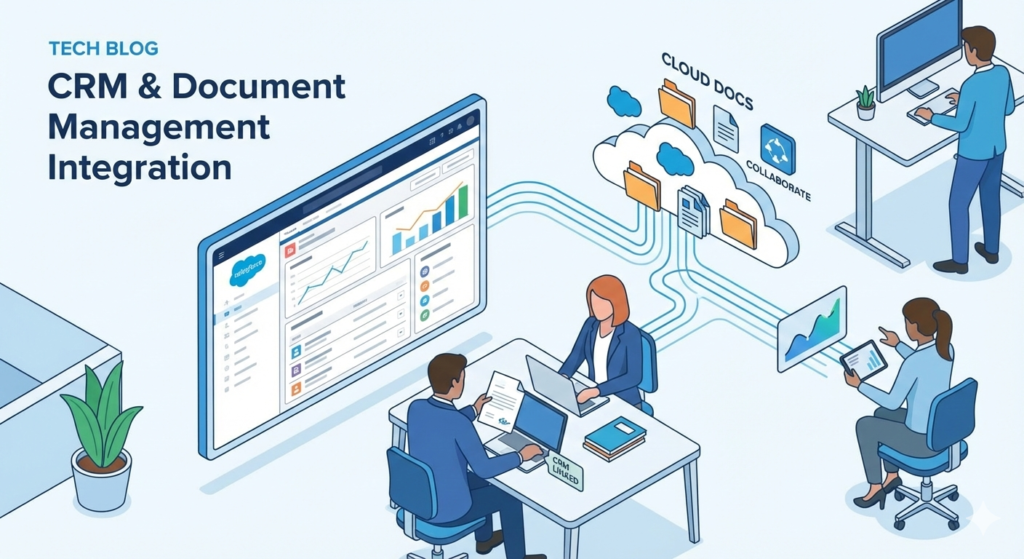
Customer relationship management systems have become the operational backbone for modern organizations. However, CRMs alone cannot manage the growing volume of documents generated daily. Contracts, proposals, invoices, onboarding files, and compliance records often live in disconnected systems. As a result, teams waste time searching for information and duplicating efforts.
Therefore, integrating CRM platforms with document management apps has become a strategic necessity. Many organizations partner with Salesforce integration companies to streamline document access, automate workflows, and maintain data consistency across systems. When documents and customer data work together, teams collaborate faster and make informed decisions.
As businesses scale, document chaos can slow productivity and increase compliance risks. CRM integration solves this challenge by connecting structured customer data with unstructured documents. This approach creates a single, reliable source of truth.
Why CRM and Document Management Integration Matters
CRM platforms excel at tracking customer interactions and sales activities. Document management systems specialize in storage, version control, and collaboration. However, operating them separately creates operational silos.
By integrating these systems, organizations eliminate manual document uploads and downloads. Additionally, users access files directly from CRM records. This unified experience reduces errors and accelerates workflows.
Moreover, integration improves customer service quality. Teams retrieve relevant documents instantly during calls or meetings. Consequently, responses become faster and more accurate.
Common Document Management Apps Integrated with CRM
Cloud-Based Document Platforms
Popular document platforms include SharePoint, Google Drive, OneDrive, and Dropbox. These tools provide scalable storage and collaboration features. When connected to CRM systems, documents automatically associate with accounts, opportunities, or cases.
This automation ensures that files remain organized without user intervention. As a result, teams focus on customers rather than file management.
Enterprise Content Management Systems
Larger organizations often rely on enterprise content management tools like Box or OpenText. These platforms support advanced security, compliance, and audit requirements. CRM integration allows controlled access to sensitive documents while maintaining regulatory standards.
Key Benefits of CRM Integration with Document Management Apps
Improved Data Accessibility
Integrated systems allow users to access documents directly from CRM records. This eliminates the need to switch between platforms. Consequently, productivity increases across departments.
Enhanced Collaboration
Teams collaborate on documents in real time while maintaining CRM context. Sales, marketing, and support teams work from the same information. Therefore, alignment improves significantly.
Stronger Data Governance
Integration enforces consistent naming conventions, permissions, and retention policies. This consistency reduces compliance risks. Additionally, audit trails become easier to maintain.
How Integration Supports Sales Teams
Sales teams rely heavily on documents such as proposals and contracts. CRM integration ensures these files stay connected to deals throughout the pipeline.
When documents update automatically, sales representatives avoid outdated information. Moreover, approval workflows trigger based on CRM events. This automation shortens sales cycles and improves win rates.
Impact on Customer Support and Service
Customer service teams benefit from instant access to support documents and case files. Integrated systems allow agents to retrieve relevant files during live interactions.
As a result, resolution times decrease and customer satisfaction improves. Additionally, knowledge base documents stay synchronized with CRM case histories.
Security and Compliance Considerations
Role-Based Access Control
Integrated systems enforce permissions based on CRM roles. This ensures that sensitive documents remain protected. Therefore, only authorized users gain access.
Regulatory Compliance
Industries such as healthcare and finance require strict document controls. CRM integration helps maintain compliance with regulations like GDPR and HIPAA. Automated retention policies further reduce risk.
Best Practices for Successful CRM and Document Integration
Define Clear Use Cases
Organizations should identify document workflows that benefit most from integration. Clear goals ensure measurable outcomes. Therefore, planning becomes essential.
Standardize Naming and Metadata
Consistent naming conventions improve searchability. Metadata synchronization ensures accurate document categorization. Consequently, retrieval becomes faster.
Prioritize User Adoption
Training users on integrated workflows increases adoption. Simple interfaces encourage consistent usage. As a result, integration delivers maximum value.
Challenges and How to Overcome Them
Data Synchronization Issues
Poorly designed integrations can cause duplication or mismatched records. Regular audits help maintain data accuracy. Additionally, automation rules should be carefully configured.
Change Management Resistance
Employees may resist new workflows. Clear communication and training reduce resistance. Over time, efficiency gains encourage adoption.
Future Trends in CRM and Document Integration
Artificial intelligence will play a growing role in document classification and retrieval. AI-powered search will surface relevant files automatically. Furthermore, predictive analytics will recommend documents based on CRM activity.
Low-code integration platforms will also simplify deployments. As technology evolves, integration will become faster and more customizable.
Conclusion
CRM integration with document management apps is no longer optional for data-driven organizations. It improves efficiency, collaboration, and compliance while reducing operational friction.
By unifying customer data with critical documents, teams work smarter and respond faster. Ultimately, this integration strengthens customer relationships and supports scalable growth. Organizations that invest in seamless integration gain a long-term competitive advantage