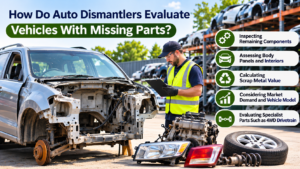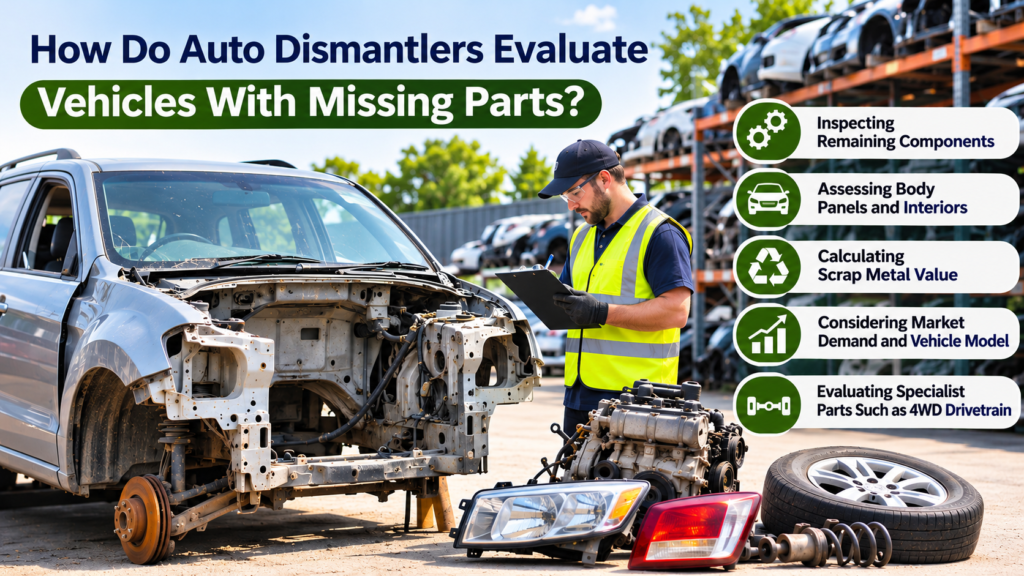
Selling a damaged or incomplete vehicle can be confusing, especially when important components have already been removed. Many car owners assume that a vehicle without an engine, transmission, wheels, or other essential parts has little value. However, auto dismantlers use several assessment methods to determine what an incomplete vehicle is worth.
The evaluation process involves examining the remaining components, identifying reusable materials, checking market demand, and estimating recovery costs. Even vehicles that cannot operate may contain valuable parts and recyclable metals.
Understanding how auto dismantlers evaluate vehicles with missing parts helps owners set realistic expectations and make informed decisions before selling.
Why Missing Parts Affect Vehicle Valuation
A vehicle’s value in the dismantling industry depends largely on what can be recovered from it. Unlike conventional used car buyers, auto dismantlers are not necessarily concerned with whether a vehicle can return to the road. Their primary interest is the remaining components and materials.
Businesses providing junk car removal Brisbane services may assess incomplete vehicles according to their condition, remaining parts, recyclable metal content, and collection requirements.
Missing components influence the evaluation because they reduce potential resale opportunities. For example, a vehicle without an engine may still contain a functional transmission, alternator, suspension components, and body panels. However, removing several major mechanical components can significantly reduce its recoverable value.
The impact also depends on the vehicle model. Parts from certain vehicles remain valuable because replacement components are expensive or difficult to obtain.
How Auto Dismantlers Inspect Incomplete Vehicles
The inspection process usually begins with identifying the vehicle’s make, model, manufacturing year, and overall condition. These details help dismantlers estimate the availability and demand for its remaining components.
An initial assessment may involve photographs, vehicle identification information, and a description of missing parts. For incomplete vehicles, accurate information is particularly important because standard valuation assumptions may not apply.
During a physical inspection, dismantlers examine the engine compartment, transmission area, suspension, interior, electrical systems, and exterior panels. They also check for accident damage, corrosion, and evidence of previous repairs.
The purpose is to determine which components can be safely removed, tested, and potentially resold.
A vehicle with several missing parts may still receive a reasonable assessment when its remaining components are in good condition.
The Importance of Remaining Mechanical Components
Mechanical components often represent a substantial portion of a dismantled vehicle’s recoverable value.
Engines, transmissions, differentials, steering assemblies, and suspension systems can attract demand in the used automotive parts market. Their condition, compatibility, and availability influence how much dismantlers are willing to pay.
For example, a vehicle missing its engine but retaining a functional automatic transmission may still offer useful recovery opportunities.
Similarly, a vehicle without its transmission may contain a reusable engine, cooling system, alternator, starter motor, and other mechanical components.
Dismantlers generally consider whether these parts can be inspected and tested before resale. Components with uncertain operating conditions may receive lower valuations because they involve additional testing costs and potential warranty risks.
The presence of a valuable component does not automatically guarantee a higher offer. Its actual condition and resale potential remain important.
How Missing Engines and Transmissions Influence Prices
Engines and transmissions are among the most significant components considered during vehicle dismantling assessments.
When either component is missing, the vehicle loses a potential source of resale revenue. However, the extent of the reduction depends on the vehicle’s age, mechanical design, and demand for replacement parts.
A relatively modern vehicle with a missing engine may still contain valuable electronic modules, sensors, body panels, and interior equipment.
An older vehicle with limited demand for replacement components may depend more heavily on its recyclable metal value.
Dismantlers also consider whether the removal process damaged surrounding components. Poorly removed engines or transmissions can leave broken wiring, damaged mounting points, and disconnected cooling systems.
Such damage may reduce the value of parts that would otherwise remain reusable.
Consequently, two vehicles of the same model with identical missing components can receive different offers.
Evaluating Body Panels, Interiors, and Electrical Parts
Mechanical components are not the only valuable elements of an incomplete vehicle.
Doors, bonnets, bumpers, headlights, mirrors, seats, dashboards, and electronic modules may retain resale potential when they remain in usable condition.
Body panels are particularly useful when they match popular vehicle models and have minimal corrosion or accident damage.
Electrical components also require careful consideration. Modern vehicles contain control modules, sensors, infotainment systems, and specialised electronic equipment that can be expensive to replace.
However, these components must be compatible with specific vehicle configurations. Some electronic modules require programming or additional verification before installation.
Interior components are assessed for wear, water damage, missing fittings, and general condition.
A vehicle missing major mechanical parts may therefore retain meaningful value through its body, interior, and electrical systems.
How Scrap Metal Weight Determines Minimum Recovery Value
When a vehicle has few reusable components, recyclable metal becomes an important part of its valuation.
Auto dismantlers estimate the recoverable weight of steel, aluminium, copper, and other metals remaining in the vehicle.
The vehicle’s original weight provides a starting point, but missing components must be considered. Removing an engine, transmission, wheels, or suspension assemblies can substantially reduce the remaining metal weight.
Metal prices also fluctuate according to market conditions, processing requirements, and demand from recycling facilities.
A heavier vehicle does not necessarily produce a proportionally higher payment because some materials require additional separation and processing.
Dismantlers must also account for nonmetallic materials, fluid removal, transportation, and recycling expenses.
As a result, scrap metal value generally provides a recovery baseline rather than a guaranteed purchase price.
Why Vehicle Make, Model, and Market Demand Matter
Demand for replacement components varies considerably between vehicle manufacturers and models.
Popular vehicles may have strong demand for commonly replaced parts, while less common vehicles can attract interest because certain components are difficult to source.
However, rarity does not always translate into higher value. Limited demand may make unusual components harder to sell.
Dismantlers consider local vehicle ownership patterns, component compatibility, inventory levels, and expected resale time.
For example, a common commercial vehicle with missing mechanical components may still contain doors, lighting assemblies, and suspension parts that are regularly requested.
A vehicle with extensive damage and limited demand may offer fewer recovery opportunities.
Market demand therefore helps explain why two incomplete vehicles with similar metal weight can receive different valuations.
How Auto Dismantlers Assess Incomplete 4WD Vehicles
Four wheel drive vehicles require additional consideration because they often contain specialised drivetrain and off road components.
Transfer cases, differentials, axles, suspension assemblies, and body accessories may retain value even when the engine or transmission is missing.
Owners researching the best 4WD wreckers Brisbane should consider whether a dismantler understands the compatibility and resale demand of these specialised components.
For example, a damaged 4WD without an engine may still contain usable drivetrain assemblies, wheels, steering components, and exterior accessories.
However, modifications, corrosion, off road damage, and previous repairs can influence the condition of these parts.
Dismantlers also examine whether aftermarket accessories can be safely removed and reused.
Accurate identification of remaining components is essential because 4WD parts can vary significantly between model generations and configurations.
How to Prepare an Incomplete Vehicle for Assessment
Vehicle owners can improve the accuracy of an assessment by providing complete information before requesting a quote.
The most useful details include the vehicle’s make, model, year, general condition, and a clear description of missing components. Photographs showing the exterior, interior, engine compartment, and damaged areas can help dismantlers identify what remains.
Owners should also disclose whether the vehicle has wheels, whether it can roll, and whether access for collection is restricted. These factors can affect transportation costs.
Documentation establishing ownership may also be required before a vehicle can be purchased or collected.
It is generally advisable to avoid removing additional components after receiving a quote because the original assessment may no longer reflect the vehicle’s condition.
Providing accurate details reduces misunderstandings and helps both parties establish realistic expectations.
Conclusion
Auto dismantlers evaluate vehicles with missing parts by examining their remaining mechanical components, body panels, electrical systems, recyclable materials, and market demand.
Although missing engines, transmissions, and other major components can reduce a vehicle’s value, they do not automatically make it worthless. The condition and resale potential of the remaining parts are often just as important.
Collection expenses, metal prices, vehicle specifications, and component compatibility also influence the final assessment.
For owners considering selling an incomplete vehicle, providing accurate information and understanding these valuation factors can make the process more transparent and help them compare offers effectively.