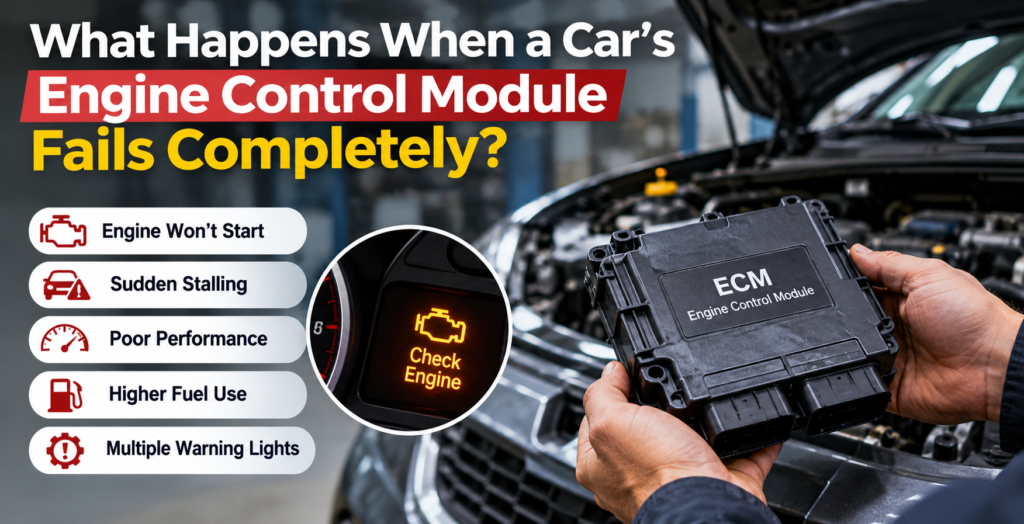
Modern vehicles rely on electronic systems to manage engine performance, fuel consumption, emissions, and overall reliability. One of the most important components is the Engine Control Module, commonly known as the ECM. This electronic unit acts as the engine’s control center, processing information from sensors and adjusting engine operations.
When an ECM fails completely, the consequences can range from an engine that refuses to start to a vehicle that suddenly stops running. Understanding how this failure affects a car can help owners recognize warning signs, avoid unnecessary repairs, and decide whether restoring the vehicle is financially worthwhile.
What Is an Engine Control Module and How Does It Work?
The Engine Control Module is an electronic computer responsible for monitoring and controlling essential engine functions. It receives information from sensors measuring engine temperature, airflow, throttle position, oxygen levels, and crankshaft movement.
Using this information, the ECM determines the appropriate fuel delivery, ignition timing, and other operating parameters. These adjustments help the engine run efficiently under different driving conditions.
The ECM also communicates with other electronic modules in the vehicle. Depending on the design, these connections may involve the transmission, immobilizer, dashboard, and emissions control systems.
When the ECM operates correctly, these processes happen automatically. However, internal electrical damage, moisture exposure, overheating, or power supply problems can interrupt its ability to communicate with critical engine components.
What Happens Immediately When the ECM Fails Completely?
A complete ECM failure can prevent the engine from operating because essential instructions are no longer reaching the systems responsible for fuel injection and ignition.
If the failure occurs while driving, the engine may stall unexpectedly. The driver may lose engine power and find that the vehicle cannot restart. Steering and braking assistance may also be reduced after the engine stops, depending on the vehicle.
In other situations, the car may crank normally without starting. This happens when the starter motor continues functioning but the engine management system cannot provide the necessary control signals.
Some vehicles may also display multiple dashboard warnings or lose communication with diagnostic equipment.
When the repair cost becomes excessive, owners sometimes investigate unwanted car removal Brisbane services rather than investing in replacement electronic components. This option may be considered when the vehicle also has significant mechanical problems or limited resale value.
However, a suspected ECM failure should always be professionally diagnosed before deciding that the vehicle is beyond economical repair.
Common Warning Signs Before an ECM Stops Working
Although an ECM can fail without warning, some vehicles experience intermittent electrical or performance problems before complete failure.
Engine Stalling Without an Obvious Reason
A damaged ECM may temporarily stop controlling fuel injection or ignition. This can cause unexpected stalling, particularly when the engine is warm or operating under changing loads.
Difficulty Starting the Engine
The vehicle may require several starting attempts or occasionally refuse to start. These symptoms can also result from battery, sensor, wiring, or fuel system problems.
Check Engine Light and Diagnostic Problems
An ECM malfunction may trigger the check engine light. In some cases, diagnostic equipment cannot communicate with the module, although communication failures can also have other electrical causes.
Unusual Engine Performance
Before complete failure, an ECM with intermittent faults may contribute to rough idling, hesitation, poor acceleration, or inconsistent fuel delivery.
These symptoms are not exclusive to ECM failure, making accurate diagnosis essential.
What Causes an Engine Control Module to Fail?
Several electrical and environmental conditions can damage an ECM. Understanding these causes helps explain why some failures occur suddenly while others develop gradually.
Water and moisture damage: Flooding, leaking seals, or water entering electronic compartments can corrode circuit boards and electrical connections.
Voltage irregularities: Electrical surges, charging system faults, or incorrect jump starting procedures can damage sensitive electronic components.
Excessive heat: Prolonged exposure to high temperatures may contribute to deterioration of internal electronic connections and components.
Wiring and grounding problems: Damaged wiring, short circuits, and poor grounding can interrupt module operation or contribute to electrical damage.
Internal component deterioration: Age, vibration, and repeated thermal cycling may eventually affect solder joints and electronic circuitry.
Importantly, an ECM that appears defective may actually be experiencing an external power supply or communication problem.
Can a Car Still Run With a Completely Failed ECM?
In most modern vehicles, an engine cannot operate normally when its primary ECM has completely stopped functioning.
The engine depends on electronic instructions for essential processes such as fuel injection and ignition control. Without these signals, combustion may not occur correctly or at all.
A vehicle with a partially functioning ECM may continue running with reduced performance or intermittent problems. Some systems can also use predetermined operating values when individual sensors fail.
However, this type of backup operation should not be confused with complete ECM failure.
If the engine stalls while driving, the safest response is to move the vehicle to a secure location when possible and arrange professional assistance. Repeated starting attempts should be avoided if there are signs of electrical damage.
How Do Mechanics Diagnose Complete ECM Failure?
Diagnosing a failed ECM requires more than reading an error code. Technicians must eliminate other possible causes before confirming that the module itself is defective.
The process typically begins with checking battery voltage, fuses, relays, wiring connections, and grounding points.
A diagnostic scanner may then be used to examine communication between electronic control units. If the ECM cannot communicate, technicians investigate whether the problem originates from the module, its electrical supply, or the vehicle communication network.
Further testing may involve checking sensor signals, connector terminals, and relevant circuits using appropriate diagnostic equipment.
Professional diagnosis is particularly important because replacing a functioning ECM will not resolve problems caused by damaged wiring or faulty power connections.
Is Replacing a Failed ECM Worth the Cost?
Replacing an ECM can restore normal engine operation when the module is confirmed defective and no additional faults remain.
However, replacement costs vary considerably depending on the vehicle’s manufacturer, model, age, and electronic architecture.
Some vehicles accept a compatible replacement module after programming, while others require immobilizer synchronization, software configuration, or additional security procedures.
Used or refurbished modules may reduce component costs, but compatibility must be verified carefully.
Before approving replacement, owners should compare the total repair estimate against the vehicle’s market value and overall mechanical condition.
For a relatively new vehicle in good condition, replacement may be reasonable. For an older car with transmission problems, corrosion, or extensive electrical damage, the investment may be difficult to justify.
What Happens to Vehicles That Are Not Economical to Repair?
When an ECM failure makes a vehicle uneconomical to restore, the car may still contain reusable components and recyclable materials.
Professional junk car dismantlers Brisbane businesses may assess vehicles for salvageable parts, including body panels, wheels, transmissions, interior fittings, and other components that remain in suitable condition.
During dismantling, reusable parts can be inspected and recovered, while metals and other recyclable materials are separated for further processing.
Fluids, batteries, and electronic components require appropriate handling to reduce environmental risks.
The failed ECM itself may also be suitable for specialist electronic recycling, depending on its condition and available recycling facilities.
This process allows useful vehicle materials to be recovered even when the engine management system can no longer be repaired economically.
Conclusion
A completely failed Engine Control Module can prevent a vehicle from starting, cause unexpected engine stalling, and interrupt communication between essential electronic systems. Although these symptoms can indicate serious damage, they do not automatically confirm that the ECM requires replacement.
Electrical testing and professional diagnosis are necessary to distinguish genuine module failure from wiring, power supply, sensor, or communication faults.
When replacement is practical, a correctly programmed ECM may restore reliable operation. However, if repair expenses exceed the vehicle’s reasonable value, dismantling and recycling may provide a more economical alternative.
Understanding the causes, symptoms, and repair considerations of ECM failure helps vehicle owners make informed decisions while avoiding unnecessary expenses.