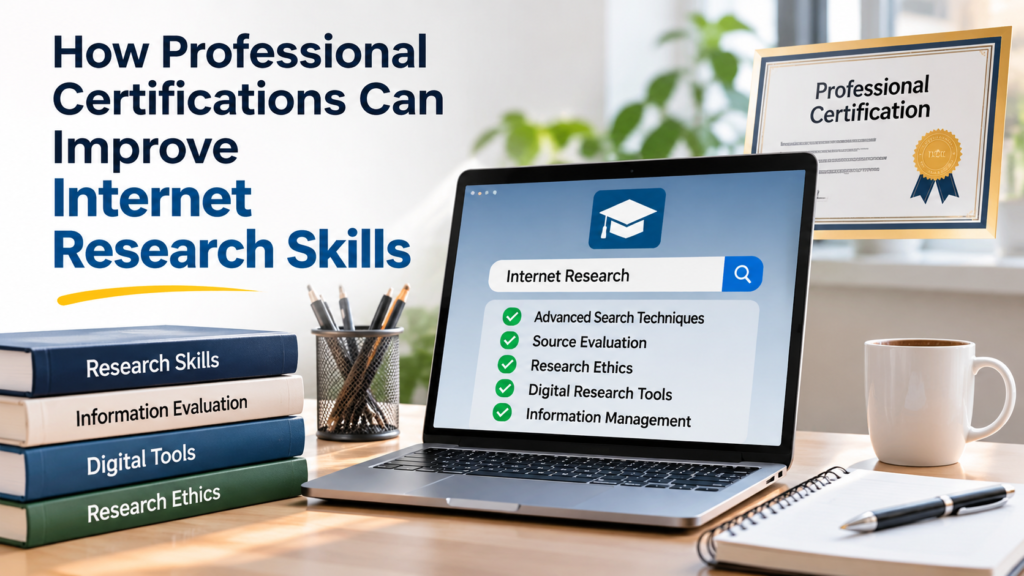
The internet provides access to an enormous amount of information, but finding accurate and reliable sources requires more than basic searching skills. Researchers must know how to identify trustworthy information, evaluate sources, and organize findings effectively. As online information continues to expand, professional research skills have become increasingly valuable across different industries.
Professional certifications offer structured learning opportunities that help individuals develop advanced search techniques, improve information evaluation, and understand ethical research practices. These programs can benefit students, journalists, business professionals, academic researchers, and anyone who regularly works with online information.
Understanding how certifications contribute to research development can help individuals improve their abilities and approach complex information searches with greater confidence.
Understanding the Importance of Professional Research Skills
Internet research involves much more than entering keywords into a search engine. Effective researchers understand how information is indexed, how search algorithms influence results, and how different sources should be evaluated.
Without proper research skills, individuals may rely on outdated articles, misleading websites, or incomplete information. These mistakes can affect academic work, business decisions, and professional reports.
Structured training helps researchers develop systematic methods for gathering and analyzing information. Instead of depending on random searches, trained professionals can use organized strategies to locate relevant material.
These skills are particularly useful when researching complex subjects that require information from multiple sources.
Learning Advanced Search Techniques
One of the main advantages of professional certification programs is exposure to advanced internet search methods.
Most internet users rely on simple keyword searches. However, experienced researchers use specialized techniques to narrow results and locate specific information.
Certification courses may introduce Boolean operators, exact phrase searches, domain restrictions, file type searches, and advanced search filters.
For example, using the site operator allows researchers to search within a particular website, while file type filters can help locate PDF reports or official documents.
Understanding these techniques improves research efficiency and reduces the time spent reviewing irrelevant results.
Advanced search skills are especially valuable for professionals who regularly investigate technical subjects, market trends, or historical information.
Developing Better Information Evaluation Skills
Finding information is only the first stage of effective research. Determining whether that information is reliable is equally important.
Professional certification programs often emphasize source evaluation, helping participants distinguish credible evidence from questionable material.
Researchers learn to examine authorship, publication dates, supporting references, editorial standards, and potential conflicts of interest.
For example, information published by a recognized academic institution may carry different evidentiary weight than an anonymous opinion posted online.
However, credibility should never be determined by reputation alone. Researchers must also evaluate whether the information is relevant, current, and supported by evidence.
These practices reduce the risk of relying on misinformation and improve the overall quality of research findings.
Building Confidence Through Professional Certification
Formal training can help individuals develop confidence in their research abilities by providing structured lessons and practical assessments.
A professional researcher certification may cover search strategies, information verification, research ethics, and digital investigation methods, depending on the issuing organization and curriculum.
Completing a relevant program can demonstrate that an individual has studied established research practices and successfully met specific assessment requirements.
However, certifications vary in quality and recognition. Before enrolling, learners should examine the course syllabus, instructor qualifications, assessment methods, and professional relevance.
Certification is most valuable when the knowledge gained can be applied to actual research tasks rather than simply added to a resume.
Improving Research Accuracy and Efficiency
Research accuracy depends on collecting relevant information and interpreting it correctly.
Professional training introduces techniques that help researchers organize their searches, document sources, and verify important findings.
Instead of searching repeatedly without a clear direction, researchers can establish objectives and develop a logical investigation process.
For example, someone researching an emerging technology might begin with academic publications, examine industry reports, and compare findings with official documentation.
This approach reduces unnecessary searching and helps identify conflicting information.
Researchers also learn to maintain records of useful sources, making it easier to revisit evidence and support conclusions.
Over time, these habits can improve both productivity and research quality.
Understanding Ethical and Responsible Research Practices
Ethical considerations are an essential part of professional internet research.
Researchers frequently encounter personal information, copyrighted materials, restricted databases, and sensitive records.
Certification programs may provide guidance on privacy protection, responsible data collection, proper attribution, and compliance with applicable regulations.
Understanding these principles helps researchers recognize the difference between publicly accessible information and information that should not be collected or disclosed without authorization.
Ethical research also involves presenting findings accurately and avoiding selective use of evidence.
For example, researchers should not ignore reliable information simply because it contradicts their initial assumptions.
Responsible practices strengthen professional credibility and help maintain trust in research outcomes.
Expanding Knowledge of Digital Research Tools
Modern internet research often requires more than traditional search engines.
Researchers may use academic databases, digital archives, government repositories, specialized search platforms, and information management software.
Professional training can introduce these resources and explain when each tool is appropriate.
Academic databases can help locate scholarly publications, while government websites may provide official statistics and regulatory information.
Reference management tools can assist with organizing citations, and spreadsheet applications can support data comparison.
Learning how to select appropriate tools helps researchers work more effectively across different subjects.
It also reduces dependence on a single search platform, which may not provide comprehensive coverage of every topic.
Supporting Career Development and Professional Opportunities
Strong internet research skills are useful across numerous professions.
Journalists investigate sources and verify claims. Marketing professionals study competitors and consumer behavior. Business analysts examine market conditions, while academic researchers evaluate published evidence.
Professional certifications can support career development by helping individuals demonstrate relevant training and commitment to continued learning.
They may also help professionals identify skill gaps and develop expertise in specialized research areas.
However, certification alone does not guarantee employment or professional advancement.
Employers may also consider practical experience, analytical ability, communication skills, and the quality of previous research work.
Combining formal training with practical projects provides a stronger foundation for long term professional growth.
Encouraging Continuous Learning and Adaptability
Internet research methods continue to evolve as search technologies, digital platforms, and information sources change.
Artificial intelligence tools have introduced additional ways to summarize documents, identify patterns, and explore research questions.
However, automated systems can produce inaccurate information or reference sources incorrectly.
Researchers must understand how to verify AI generated findings against reliable original sources.
Professional development programs can encourage continuous learning by introducing new research methods and reinforcing critical thinking.
Regular practice, updated training, and familiarity with emerging tools help researchers maintain their effectiveness.
Adaptability is particularly important in fields where accurate information influences important decisions.
Conclusion
Professional certifications can improve internet research skills by providing structured training in advanced searching, source evaluation, information management, and ethical research practices.
They help individuals develop systematic approaches to finding reliable information while improving accuracy, efficiency, and confidence.
Certification programs can also support professional development by introducing specialized tools and encouraging continuous learning.
However, the greatest benefits come from applying these skills consistently in practical situations. A certificate represents completed training, while genuine research expertise develops through experience, critical thinking, and careful verification.
By combining professional education with regular practice, individuals can become more capable researchers and make better use of the information available online.