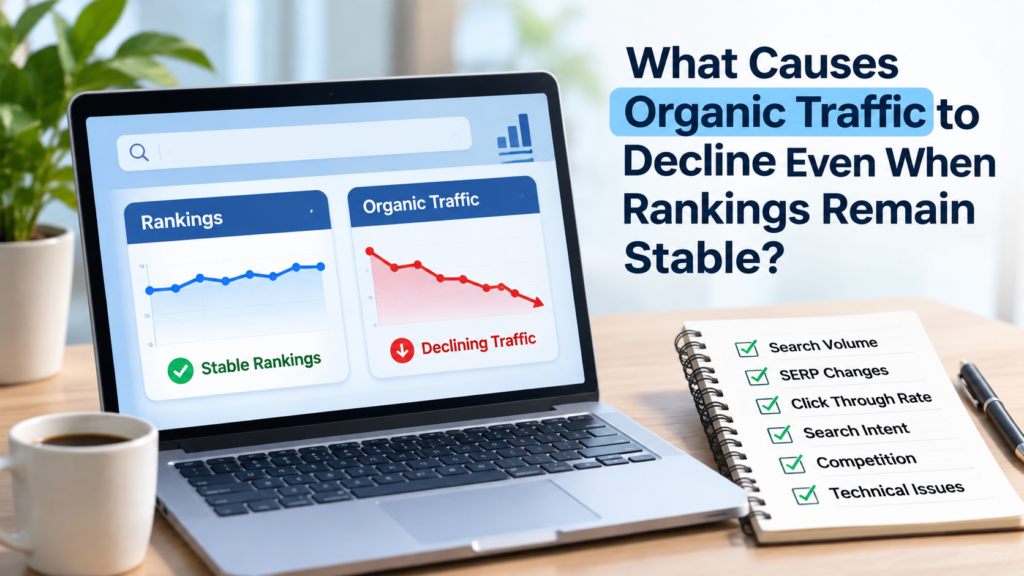
Organic traffic is one of the most important indicators of a website’s search performance. Businesses invest considerable time and resources in improving keyword rankings, creating useful content, and maintaining technical SEO. However, a website can experience declining organic traffic even when its keyword positions remain relatively stable.
This situation often creates confusion because higher rankings are generally associated with increased visibility and website visits. In reality, search rankings represent only one part of organic search performance. Changes in search demand, user behavior, search results, and competition can affect traffic without significantly changing keyword positions.
Understanding these factors helps website owners identify the actual reasons behind traffic losses and develop effective strategies to maintain organic visibility.
1. Declining Search Volume for Target Keywords
One of the most common reasons for declining organic traffic is reduced search demand. A website may maintain the same position for a keyword while fewer people search for that particular term.
Search volume changes because of seasonal trends, economic conditions, consumer preferences, and developments within an industry. For example, searches related to holiday shopping naturally decrease after the holiday season.
Similarly, interest in certain technologies or services may decline as newer alternatives become available.
Website owners should examine search impressions in Google Search Console to identify whether fewer searches are contributing to traffic losses. Google Trends can also help reveal changes in broader search interest.
If impressions decline while average rankings remain stable, reduced demand may be an important contributing factor.
2. Changes in Google Search Results Layout
Google search results have evolved considerably. Traditional organic listings now compete for attention with featured snippets, advertisements, local results, shopping features, and AI generated summaries.
These elements can change how users interact with search results, even when a website maintains its previous ranking.
For example, a page ranking third organically may receive fewer clicks when advertisements, AI Overviews, or other search features appear above it.
Users may also find sufficient information directly within the search results without visiting a website.
This behavior can reduce organic click through rates despite stable keyword positions.
Monitoring search results for important keywords helps businesses understand whether changes in visibility or user behavior are affecting their traffic.
3. Lower Click Through Rates
A decline in click through rate can significantly affect organic traffic without causing a noticeable ranking change.
Click through rate measures the percentage of search impressions that result in clicks. When fewer users select a website from search results, traffic decreases even if its position remains unchanged.
Several factors can influence click through rates, including outdated page titles, unclear meta descriptions, stronger competitor messaging, and changes in search intent.
For example, a competitor may publish a more compelling title that attracts attention despite ranking below another website.
Businesses should review their search appearance and ensure that titles accurately communicate the value of each page.
Clear descriptions, relevant wording, and alignment with user expectations can improve the likelihood of attracting qualified visitors.
4. Increased Competition From Search Features
Competition in organic search extends beyond websites targeting similar keywords.
Google frequently displays videos, images, discussion forums, product listings, and other specialized results depending on the search query.
A traditional webpage may retain its ranking while receiving less attention because users increasingly prefer alternative content formats.
For instance, someone searching for instructions on repairing a household appliance may choose a video demonstration instead of a written article.
Businesses working with a white label seo provider should evaluate changes in search result features alongside keyword rankings to better understand shifts in organic traffic.
Adapting content formats to user preferences can help websites remain relevant as search behavior evolves.
5. Changes in User Search Intent
Search intent describes what users expect to accomplish when entering a query into a search engine.
Although keyword rankings may remain stable, the expectations behind certain searches can change over time.
A keyword that previously attracted informational searches may gradually develop stronger commercial intent.
For example, users researching website design may initially seek educational resources but later become more interested in comparing service providers and pricing.
If an existing page no longer matches what searchers want, fewer people may choose to visit it.
Reviewing current search results, related questions, and competitor content can help identify these changes.
Updating content to address relevant user needs may improve engagement and attract more qualified organic visitors.
6. Reduced Brand Awareness and Branded Searches
Branded searches can contribute significantly to organic website traffic. When fewer people search for a company’s name, its organic visits may decline even if its rankings remain unchanged.
Changes in advertising activity, social media visibility, public interest, or marketing campaigns can influence branded search demand.
For example, a business that reduces promotional activity may experience fewer brand related searches over time.
Companies investing in branding packages often focus on developing consistent visual identities, messaging, and brand recognition across marketing channels.
Strong brand awareness can encourage people to search directly for a business, supporting organic discovery beyond traditional keyword optimization.
Website owners should analyze branded and nonbranded search performance separately to understand which category contributes to traffic changes.
7. Technical Problems Affecting Website Accessibility
Technical SEO problems can reduce recorded organic visits even when ranking reports appear stable.
Slow loading pages, server errors, redirect problems, and mobile usability issues may prevent visitors from accessing content successfully.
For example, a website experiencing intermittent server problems may remain visible in search results while some users cannot load its pages.
Analytics tracking problems can also create misleading traffic reports. Missing tracking codes, incorrect configurations, or changes in consent settings may cause recorded sessions to decline without an equivalent reduction in actual visits.
Regular technical audits help identify these issues.
Website owners should examine server performance, tracking implementation, page accessibility, and indexing reports before assuming that search visibility has deteriorated.
8. Differences Between Ranking Reports and Actual Search Performance
Keyword tracking tools provide useful information, but they do not always represent the complete search environment.
Rankings can vary according to location, device, personalization, and the specific search queries users enter.
A tracking platform may report stable positions for selected keywords while traffic declines across hundreds of other queries.
Google Search Console provides broader information about the searches generating impressions and clicks.
Website owners should compare performance across individual pages, devices, countries, and search queries.
This approach can reveal traffic losses that are not visible in a limited keyword ranking report.
Understanding these differences prevents businesses from making decisions based on incomplete information.
9. How to Diagnose and Recover Declining Organic Traffic
Identifying the cause of declining organic traffic requires a structured investigation rather than immediate changes to website content.
Begin by comparing Google Search Console data across equivalent periods. Examine clicks, impressions, average position, and click through rate.
If impressions decrease while rankings remain stable, investigate search demand and seasonal patterns. If impressions remain consistent but clicks decline, examine search result features and page titles.
Next, review Google Analytics data to identify changes in organic landing page sessions and engagement.
Check technical performance, mobile accessibility, and analytics tracking accuracy.
Finally, evaluate whether existing content continues to satisfy current search intent.
The appropriate solution depends on the underlying cause. Some pages may benefit from updated content, while others require technical improvements, better search result presentation, or broader marketing efforts.
Conclusion
Organic traffic can decline even when keyword rankings remain stable because search performance depends on more than position alone. Reduced search demand, changing search results, lower click through rates, shifting user intent, and technical issues can all influence website visits.
Businesses should avoid assuming that stable rankings guarantee consistent traffic. Instead, they should examine search impressions, user behavior, technical performance, and changes in the competitive environment.
Regular monitoring and accurate analysis help identify the reasons behind traffic fluctuations. By addressing the actual causes rather than focusing exclusively on rankings, website owners can protect organic visibility, improve user engagement, and support sustainable search performance over time.