Let’s be honest. Nobody gets excited about inverters. You get excited about what they let you do. Hot coffee in the middle of nowhere. A microwave dinner after a long hike. Charging the drone, laptop, and camera all at once without fighting over a cigarette-lighter socket.
That’s where a decent-sized inverter comes in.
Why 2000 Watts is the Sweet Spot
Go too small, and you’re stuck charging phones. Go huge, and you’re paying for power your battery can’t really supply anyway. A 2000 watt pure sine wave power inverter lands in the middle. It’ll run a coffee maker, a compact microwave, most power tools, a TV, and a pile of chargers. Not all at full blast at once, mind. One big thing plus a few little things, and you’re golden.
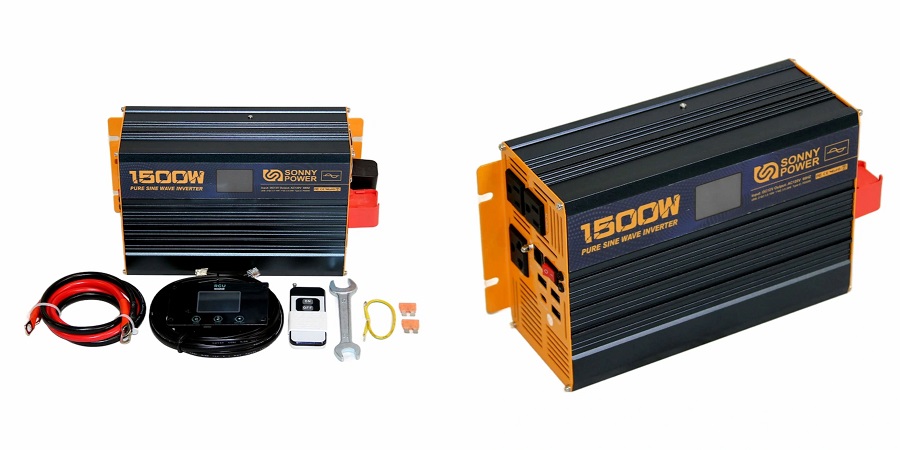
Take the 2000-watt pure sine wave power inverter from Sonny Power. 2000W continuous. 4000W peak. US outlets, three USB ports, and a USB-C port up front. An LCD screen so you can actually see what you’re drawing. And two remotes, one wired and one wireless, which you’ll appreciate the first time you mount the thing somewhere annoying to reach.
Efficiency is up to 94%. Warranty’s two years. Price right now is $224.99.
That 4000W Peak Isn’t Just Marketing
Here’s something people miss. Fridges, pumps, and compressors don’t start gently. They yank a big surge of power for a second or two, sometimes double their running draw. If your inverter can’t handle that spike, it trips. Every. Single. Time.
The 4000W peak prevents that.
Why Bother With a 2000W Pure Sine Wave Inverter?
You could save money with a modified sine wave model. Plenty of people do. Then their laptop charger starts whining, the microwave sounds weird, and the CPAP gets grumpy.
Modified sine is a rough, blocky imitation of the power from your wall. Fine for a space heater. Not so fine for anything with sensitive electronics or a variable-speed motor. A 2000w pure sine wave inverter gives you the smooth stuff, and this one is rated under 3% distortion. (If you’re running a medical device, double-check its own requirements too. Always worth it.)
The Battery Question Nobody Wants to Answer
How long will it last? Depends on what you plug in. But here’s the quick math.
A 100Ah 12V lithium battery holds about 1.2 kWh. Pull 1000W steadily, and you’ll get roughly an hour. A five-minute microwave session? Barely a blip. Running a space heater all evening? You’ll want a much bigger battery bank. Simple as that.
Wiring a 2000W Pure Sine Wave Inverter (Please Don’t Skip This)
This is where people get into trouble.
At full output, you’re pulling something like 170 to 180 amps out of a 12V battery. That’s serious current. Thin cable won’t cut it. It’ll get hot, waste power, and drop voltage.
So keep the inverter close to the battery. Use short, thick cable rated for the load. Put a proper fuse or breaker in between, sized per the manual (or ask an electrician, no shame in it).
And check your battery’s BMS. If it can’t supply that much current, it’ll cut out the second you switch on the microwave. Lithium’s the best partner here, but only if it’s built for the load.
A Few Quick Answers
Can a 2000 watt pure sine wave power inverter run a microwave?
Most compact ones, yes. Look at the input wattage on the label, not the cooking power.
12V or 24V?
This one’s 12V DC in, 120V AC at 60Hz out.
Good for power cuts?
Absolutely. Pair it with a solid battery bank, and you’ve got quiet backup for lights, Wi-Fi and laptops.
The Takeaway
Pick a 2000w pure sine wave inverter, wire it like you mean it, and give it a battery that can keep up. Do that, and outlets become something you just stop thinking about.