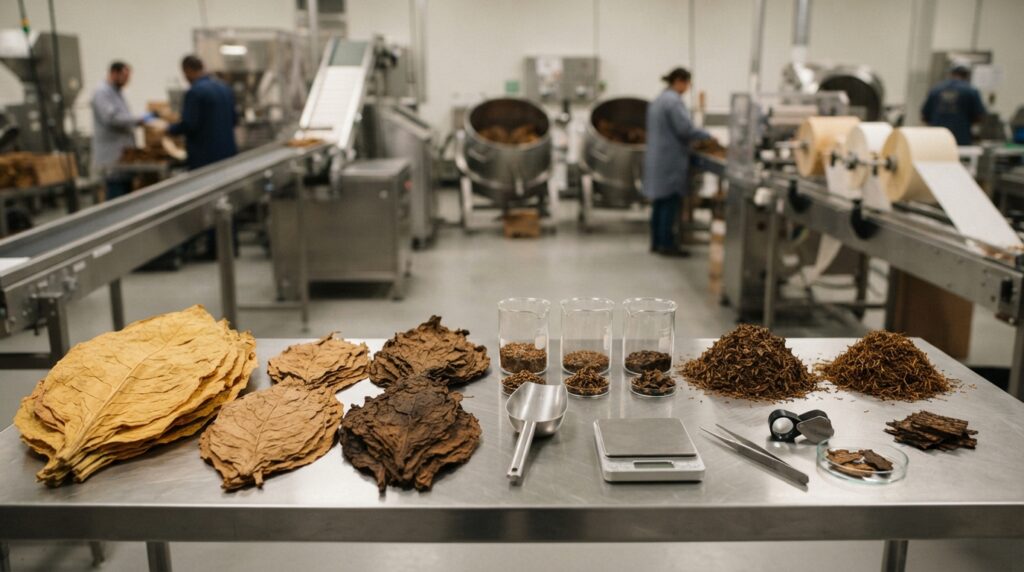
When reviewing product descriptions or researching terms such as Shop OHM pipe tobacco, readers may encounter references to tobacco blends, leaf varieties, cut styles, and processing methods. These terms describe different aspects of product composition and manufacturing. Understanding them helps explain how tobacco products are classified and produced, without implying that any tobacco product is safe.
The manufacturing process varies according to product category and applicable regulations. Nevertheless, most tobacco production systems share several broad stages. Each stage can influence the final product’s physical and chemical characteristics.
1. Understanding Tobacco Blending
Tobacco blending involves combining different tobacco materials into a formulated mixture. Manufacturers may use several leaf varieties to establish specific product specifications.
These varieties can differ in color, thickness, moisture, and chemical composition. Virginia, Burley, and Oriental tobacco are common examples used in various manufacturing contexts.
Blending decisions depend on product specifications and manufacturing standards. Companies may consider leaf origin, crop characteristics, processing history, and laboratory measurements.
A blend may contain several tobacco types. However, its exact composition depends on the manufacturer’s formulation and applicable labeling requirements.
Blending also helps manufacturers manage agricultural variation. Tobacco leaves can differ between growing seasons. Formulations may therefore require adjustments to maintain consistent production specifications.
2. Common Tobacco Varieties Used in Manufacturing
Different tobacco varieties contribute different physical and chemical characteristics. Understanding these categories provides useful context for tobacco manufacturing.
Virginia Tobacco
Virginia tobacco is commonly flue-cured. Its leaves often display yellow, golden, or light brown colors.
It generally contains more natural sugars than many air-cured varieties. However, actual levels depend on cultivation and processing conditions.
Burley Tobacco
Burley tobacco is generally air-cured. Its leaves often appear tan or light brown.
It typically contains lower sugar levels than flue-cured Virginia tobacco. Its chemical composition can vary with soil, climate, and harvesting practices.
Oriental Tobacco
Oriental tobacco includes several regional varieties. Many produce comparatively small leaves.
These leaves are commonly sun-cured. Their physical and chemical characteristics reflect local growing conditions and processing methods.
Dark Tobacco
Dark tobacco includes varieties and materials associated with darker leaf colors. Some undergo fire curing or other specialized processing.
The resulting characteristics depend on the tobacco variety and manufacturing conditions.
3. Tobacco Cultivation and Harvesting
Manufacturing begins with agricultural production. Tobacco plants grow under conditions that influence leaf development and composition.
Important cultivation factors include:
-
Soil composition and nutrient availability
-
Temperature and rainfall
-
Sunlight exposure
-
Plant variety
-
Water management
-
Pest and disease conditions
-
Agricultural practices
As plants mature, leaves develop different physical characteristics. Their size, thickness, and chemical composition can vary according to position.
Harvesting methods also differ. Some tobacco varieties are harvested leaf by leaf. Others may be harvested using different methods, depending on agricultural practices.
The timing of harvesting matters because leaf maturity influences processing characteristics. Therefore, growers monitor crop development before harvesting.
After collection, leaves move into curing and processing facilities. At this stage, their moisture and physical condition become important manufacturing considerations.
4. Curing Methods and Their Manufacturing Effects
Curing removes moisture from harvested tobacco leaves. It also produces chemical changes that influence leaf color and composition.
Different varieties may require different curing methods.
Air curing: Leaves dry through natural airflow inside ventilated structures. This method is commonly associated with Burley tobacco.
Flue curing: Controlled heat dries leaves through enclosed heating systems. Virginia tobacco is commonly processed this way.
Sun curing: Leaves dry through exposure to sunlight. This method is associated with several Oriental varieties.
Fire curing: Smoke and heat contribute to the drying process. This method can influence leaf color and chemical composition.
Curing conditions require monitoring. Temperature, humidity, airflow, and duration affect the final material.
However, curing does not remove all harmful tobacco constituents. It changes the leaf’s properties rather than making tobacco safe.
5. Leaf Conditioning and Preparation
After curing, tobacco leaves may require conditioning before further processing. Conditioning involves managing moisture and preparing leaves for subsequent manufacturing stages.
The process helps make leaves easier to handle during industrial operations. It can also reduce excessive brittleness and support consistent processing.
Manufacturers inspect incoming materials for visible defects and variations. They may separate leaves according to size, color, condition, or other specifications.
Stems and other unwanted plant materials may also be separated. The resulting tobacco material can then move through additional processing stages.
Conditioning requirements vary by tobacco type and product category. Manufacturers must also consider applicable workplace and product safety standards.
6. Sorting, Grading, and Leaf Selection
Sorting helps manufacturers organize tobacco materials before blending. It involves assessing leaves according to defined physical and production characteristics.
Common assessment factors include:
-
Leaf size and thickness
-
Color and visible condition
-
Moisture content
-
Stem proportion
-
Variety and agricultural origin
-
Previous curing or processing methods
Grading systems differ between manufacturers and regions. Some classifications rely on agricultural standards, while others reflect internal quality-control requirements.
Sorting also helps identify damaged or unsuitable materials. This supports more consistent manufacturing records and reduces unexpected variations.
However, appearance alone cannot establish the chemical composition of tobacco. Laboratory analysis is necessary for reliable measurements of specific compounds.
7. The Role of Moisture in Tobacco Manufacturing
Moisture content affects the physical condition of tobacco leaves. It can influence flexibility, weight, texture, and processing consistency.
Very dry leaves may become brittle during handling. Excessive moisture can contribute to storage problems and microbial growth.
Manufacturers monitor moisture as part of production quality control. Measurements may be taken at different manufacturing stages.
Moisture levels can also change during transportation and storage. Packaging materials and environmental conditions influence these changes.
For this reason, manufacturing records often include relevant moisture measurements. Such information helps document material conditions throughout production.
8. Cutting and Processing Methods
After preparation, tobacco may undergo cutting or other physical processing. The specific method depends on the product category and manufacturing specifications.
Common formats include ribbon cut, shag cut, flake, and plug. Each describes a different physical structure.
Ribbon cut consists of narrow strips. Shag cut generally contains finer strips. Flake tobacco is compressed into layers before being divided into smaller pieces.
Plug tobacco is formed into compact blocks. These formats differ in shape, density, and particle size.
Cutting changes the physical structure of tobacco. It does not necessarily change the original plant variety.
Manufacturers monitor cutting consistency through inspections. Particle size and material uniformity can be important product specifications.
9. How Manufacturers Develop Tobacco Blends
Blend formulation is an important part of tobacco manufacturing. It involves selecting and combining materials according to established product specifications.
Manufacturers may consider several factors when documenting a blend:
-
Tobacco variety and source
-
Leaf condition and grading
-
Moisture measurements
-
Chemical composition
-
Processing history
-
Ingredient and additive information
-
Applicable labeling requirements
Different tobacco materials may have different chemical profiles. Therefore, manufacturers maintain formulation records and production documentation.
The exact blend composition can vary between product categories. Some products contain multiple tobacco varieties, while others use narrower material classifications.
Additives may also be present in certain manufactured products. Their use and disclosure depend on product formulation and applicable laws.
A product’s name does not reveal its complete composition. Accurate ingredient information and appropriate testing provide a clearer understanding.
10. Fermentation and Aging Processes
Some tobacco materials undergo fermentation or aging after curing. These processes can produce additional changes in leaf composition.
Fermentation may involve microbial activity and chemical reactions. Temperature, moisture, and storage conditions influence the process.
During fermentation, some naturally occurring compounds may change. Leaf color and texture can also develop differently.
Aging involves changes over time under particular storage conditions. These may include oxidation and shifts in moisture distribution.
Not every tobacco variety or product undergoes fermentation. The methods also differ between manufacturers.
Importantly, fermentation and aging do not make tobacco harmless. Processed tobacco continues to carry health risks and can contain addictive nicotine.
11. Quality Control During Manufacturing
Quality control helps manufacturers assess whether materials and finished products meet established specifications.
Inspection may take place throughout production. This includes incoming leaf assessment, moisture measurement, cutting consistency, and packaging checks.
Common quality-control activities include:
-
Reviewing incoming material documentation.
-
Inspecting leaves for visible defects.
-
Recording moisture measurements.
-
Checking processing consistency.
-
Verifying product weights and packaging.
-
Reviewing labels and batch identification.
-
Maintaining production and inspection records.
Laboratory testing may measure selected chemical components. This can include nicotine, moisture, and other substances relevant to product specifications.
Testing methods must be appropriate for the material being examined. Results should also be recorded accurately.
Quality control supports manufacturing consistency. However, it does not mean a tobacco product is safe for consumption.
12. Packaging and Product Identification
Packaging is an important stage in the manufacturing process. It contains the finished product and communicates required information.
Packaging materials may include paper, cardboard, flexible films, metal containers, or composite structures.
Manufacturers select materials according to product requirements and applicable regulations. They also assess package dimensions, sealing performance, and durability.
Labels may include product identity, net weight, manufacturer details, ingredient information, and health warnings. Requirements vary between jurisdictions.
Batch numbers and identification codes support traceability. They help connect packaged products with production records.
Packaging quality is also inspected before distribution. Damaged containers or incorrect labels can create compliance and inventory problems.
13. Regulations and Manufacturing Standards
Tobacco manufacturing is subject to different laws and standards across markets. These rules may cover production, ingredients, labeling, packaging, and distribution.
Manufacturers must understand the requirements that apply to each destination. Regulations can differ between countries and product categories.
Some jurisdictions require specific health warnings. Others regulate ingredient reporting, product testing, or packaging presentation.
Documentation helps demonstrate compliance. Records may include material sources, production details, inspection results, and distribution information.
Regulatory requirements can also change. Therefore, companies need ongoing reviews of applicable laws and manufacturing procedures.
14. Health and Environmental Considerations
Tobacco manufacturing and consumption involve significant health and environmental concerns.
Tobacco contains nicotine, which is addictive. Smoking also exposes people to harmful chemicals that can damage the respiratory and cardiovascular systems.
Tobacco use is associated with cancers, heart disease, stroke, and chronic respiratory conditions. Secondhand smoke can also harm people nearby.
Processing and manufacturing do not remove these risks. Natural, blended, aged, or specially cured tobacco remains harmful.
Environmental considerations also matter. Tobacco cultivation can affect land and water resources. Manufacturing creates material waste and packaging waste.
Discarded tobacco products can contribute to environmental pollution. Responsible waste management and regulatory oversight remain important.
Conclusion
Tobacco blending and manufacturing involve several interconnected stages. These include cultivation, harvesting, curing, sorting, conditioning, cutting, blending, quality control, and packaging.
Each stage can influence the physical and chemical characteristics of tobacco. Plant variety, agricultural conditions, and processing methods contribute to differences between finished products.
Manufacturers use documentation and testing to monitor production consistency. They must also follow relevant regulations governing ingredients, packaging, labeling, and distribution.
Understanding these processes provides useful context about tobacco production. However, manufacturing methods do not eliminate tobacco’s health risks. Nicotine dependence, cancer, cardiovascular disease, and respiratory illness remain serious concerns associated with tobacco use.